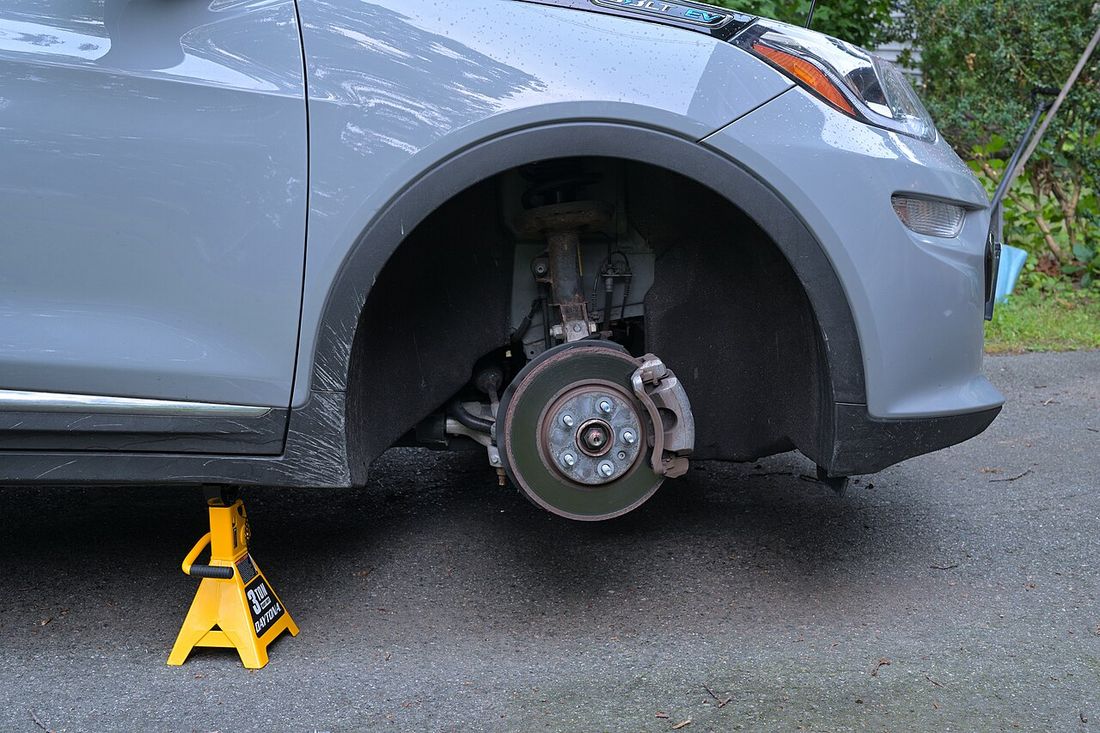
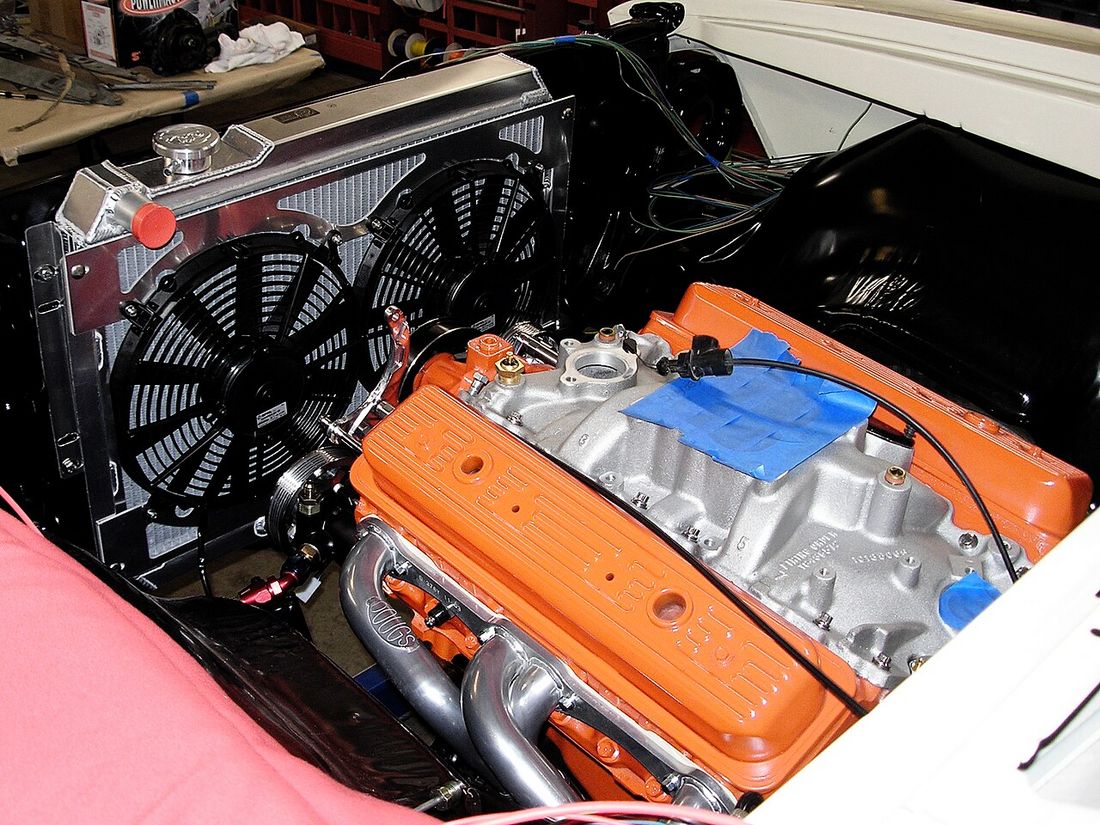
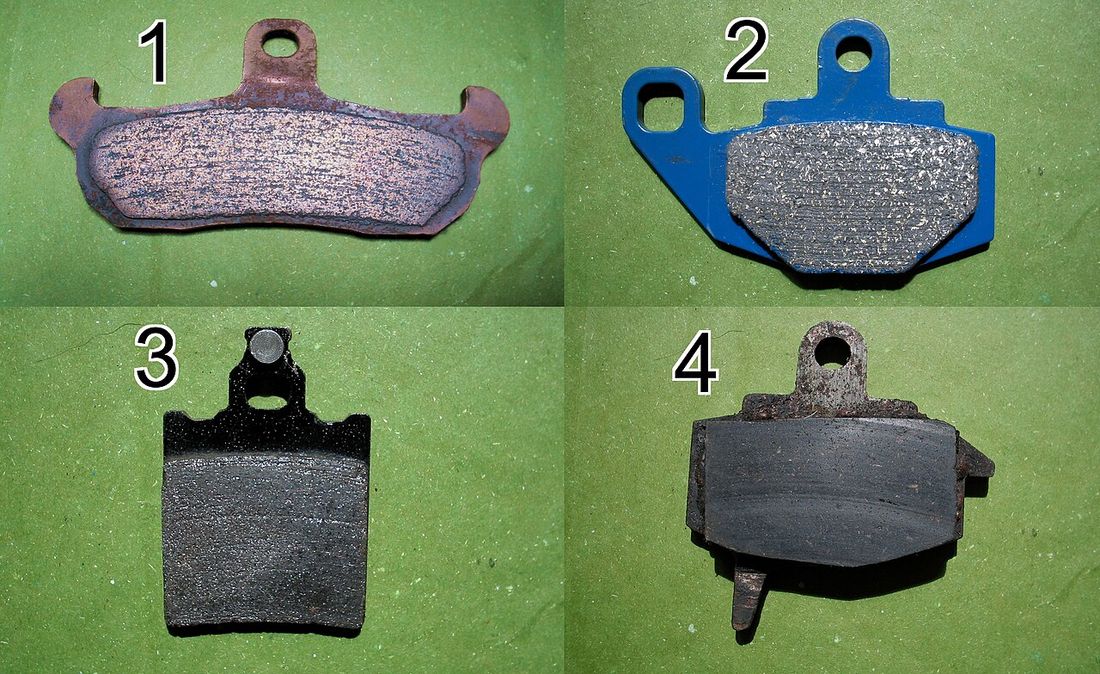
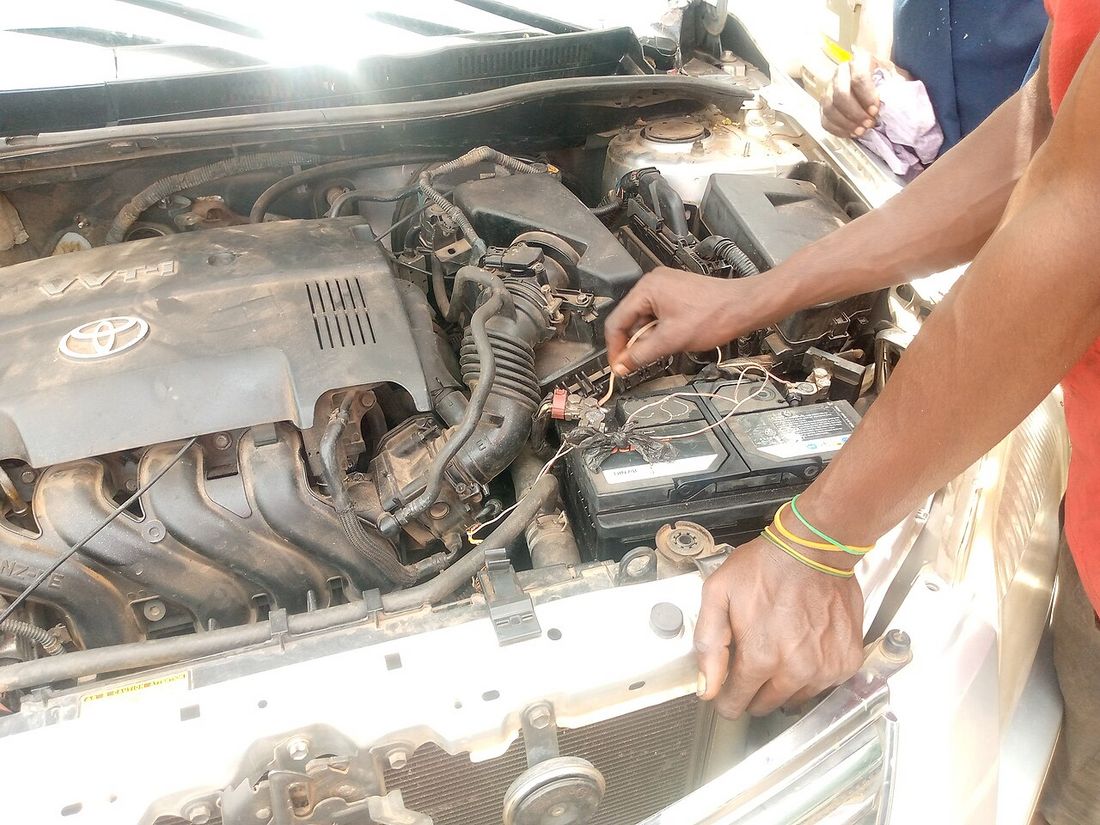
How cars actually work — explained in plain English, with the real numbers.
How cars actually work, explained plainly
No hype, no reviews, no jargon for its own sake. Just clear, step-by-step explainers on engines, electric motors, gearboxes, brakes and the warning signs your car gives you — written for drivers, students and the simply curious.
10In-depth guides
2Topics: power & problems
0Brand hype
Photo: Ethan Llamas, CC BY-SA 4.0, via Wikimedia Commons
Showing all 10 guides
Engines & Electric9 min read
How an Electric Car Works, End to End
Battery, inverter, motor, charging — the full journey of energy from the plug to the road, and an honest side-by-side with a petrol engine.
Read the guide →
Engines & Electric8 min read
How a Hybrid Car Works, Step by Step
When does the petrol engine run, when does the motor take over, and where does braking energy go? A hybrid's busy day, minute by minute.
Read the guide →
Engines & Electric8 min read
Turbocharger vs Supercharger
Both squeeze more air into an engine to make more power — but one is driven by exhaust gas and the other by a belt. The differences matter.
Read the guide →
Engines & Electric9 min read
Automatic Gearboxes Compared
Torque converter, CVT and dual-clutch: three completely different machines hiding behind the same “D” on the selector. How each one shifts, and where each is best.
Read the guide →
Ownership & Problems7 min read
How ABS Brakes Work
Why the brake pedal kicks back at you in an emergency stop — and why that pulsing is the system saving your steering, up to 15 times a second.
Read the guide →
Ownership & Problems8 min read
Why Engines Overheat: 6 Common Causes
The temperature needle is climbing. Here are the six usual culprits — and what each one can cost you if you keep driving and ignore it.
Read the guide →
Ownership & Problems8 min read
Strange Car Noises, Decoded
Squeal, grind, knock, hum, clunk: your car talks before it breaks. A plain-English dictionary of the sounds that matter — and how urgent each one is.
Read the guide →
Engines & Electric7 min read
How a Car Battery and Alternator Work Together
One starts the engine, the other keeps everything alive afterwards. How the partnership works — and how to tell which partner is failing.
Read the guide →
Engines & Electric8 min read
Petrol vs Diesel Engines: The Real Differences
One burns its fuel with a spark, the other squeezes it until it explodes on its own. Compression, torque, economy and upkeep, compared honestly.
Read the guide →
Engines & Electric7 min read
How Power Steering Works
Hydraulic muscle or an electric motor: what makes the wheel feel light at parking speeds — and the real reasons steering suddenly goes heavy.
Read the guide →
No guides match that search. Try a shorter word — “brake”, “engine”, “noise” — or clear the filter above.
Questions, answered
The things readers ask us most.
Is AutoFacts written for beginners or for mechanics?
For everyone in between. Every guide starts from zero — what the part is and why the car needs it — then goes step by step into how it really works, with the numbers included. If you already work on cars, the tables and fault sections are the parts written for you.
Are the numbers in the guides exact for my car?
They are typical real-world figures — the ranges most cars on the road actually fall into. Your car's exact figures (battery size, boost pressure, service costs) live in its owner's manual and vary by model and country. Where a figure is a range, we say so, and we never round a guess into a “fact”.
Can I repair my car myself using these guides?
These guides explain how things work so you can understand your car and talk to a workshop with confidence. They are education, not repair instructions. Brakes, steering, high-voltage EV systems and engine internals belong to qualified mechanics — several guides carry a safety note saying exactly that.
Why no car news, launches or reviews?
Because news goes stale in a week and a review is one person's week with one car. How a turbocharger works will be true in ten years. AutoFacts sticks to the lasting knowledge: how the machine works, why it fails, and what the failure sounds and looks like.
Where do the photographs come from?
Every photo is freely licensed from Wikimedia Commons and credited by name under the image and in the full credits list in the footer. No stock libraries, no watermarked previews.
Which topic should I read first?
If you drive a petrol or diesel car, start with the battery and alternator guide — it explains the two parts most likely to leave you stranded. If you are EV-curious, the electric car guide gives you the whole system in one read.
From our article network
Plain-English explainers on every subject — same idea, different garage.
A petrol car burns fuel to make movement. An electric car simply stores electricity and turns it back into movement — but the details of how it stores, converts and spends that electricity are where all the interesting engineering lives.
AutoFacts guide · 9 min read · Engines & Electric
First, the big picture
Strip an electric car down to its essentials and there are only four main actors: a large rechargeable battery under the floor, an inverter (the power electronics box), one or two electric motors, and a simple single-speed gearbox connecting the motor to the wheels. There is no exhaust system, no multi-gear transmission, no spark plugs, no oil to change in an engine — the drivetrain of a typical EV has roughly 20 moving parts where a petrol drivetrain has around 200.
Everything else — range, charging speed, performance — is decided by how those four parts work together. So let us follow the energy on its journey, from the charging plug to the tyre touching the road.
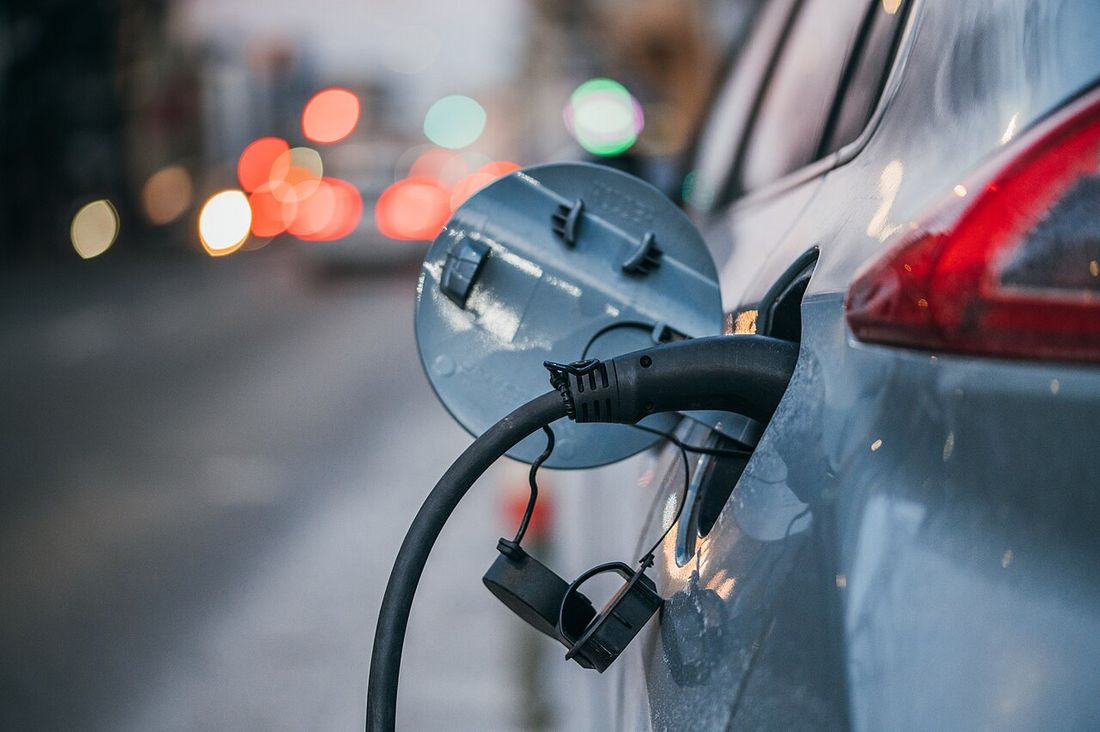
Charging is the one “refuelling” job an EV does differently: energy goes in as electricity, slowly at home or quickly at a DC fast charger. Photo: Ivan Radic, CC BY 2.0, Wikimedia Commons
Step by step: from plug to road
Charging puts energy into the battery. The battery is a pack of thousands of small lithium-ion cells wired together, storing energy as direct current (DC). Most family EVs carry between 40 and 100 kilowatt-hours (kWh) — treat the kWh figure like the size of a fuel tank. A 60 kWh pack stores roughly the energy in 6.7 litres of petrol, yet drives much further on it, for reasons explained below.
Home charging is AC; the car converts it. Wall power is alternating current (AC). An onboard charger inside the car converts AC to DC for the battery — typically at 7 to 11 kW on a home wallbox, which refills most cars overnight. A plain household socket manages only about 1.4 to 2.3 kW.
DC fast charging skips the conversion. A rapid charger on a motorway does the AC-to-DC conversion itself and feeds DC straight to the battery at 50 to 350 kW, adding roughly 100 miles (160 km) of range in 10 to 20 minutes on cars that support it — before slowing down to protect the battery as it fills.
You press the accelerator; the inverter answers. The battery's DC cannot spin a motor directly. The inverter takes DC from the battery and reshapes it into precisely controlled three-phase AC. How much power it releases, and at what frequency, decides the motor's speed and force. The inverter is, in effect, the EV's throttle, fuel system and gearbox controller in one box.
The motor turns electricity into torque. Most EVs use either a permanent-magnet motor or an induction motor. Feed it the inverter's AC and it produces turning force — torque — instantly, from a standstill. A typical family EV motor makes 150 to 300 horsepower, and because full torque arrives at zero revs, there is no clutch and no need for gears.
One gear does the rest. The motor spins far faster than the wheels should, so a fixed reduction gear of roughly 8:1 to 10:1 slows it down and multiplies the force. One ratio is enough because the motor pulls strongly from 0 rpm all the way to 15,000 rpm or more.
Lifting off the pedal puts energy back. Slow down and the motor becomes a generator: the wheels drive it, it produces electricity, and the inverter feeds that energy back into the battery. This regenerative braking recovers roughly 10 to 25 percent of the energy used in city driving — energy a petrol car throws away as heat in its brake discs.
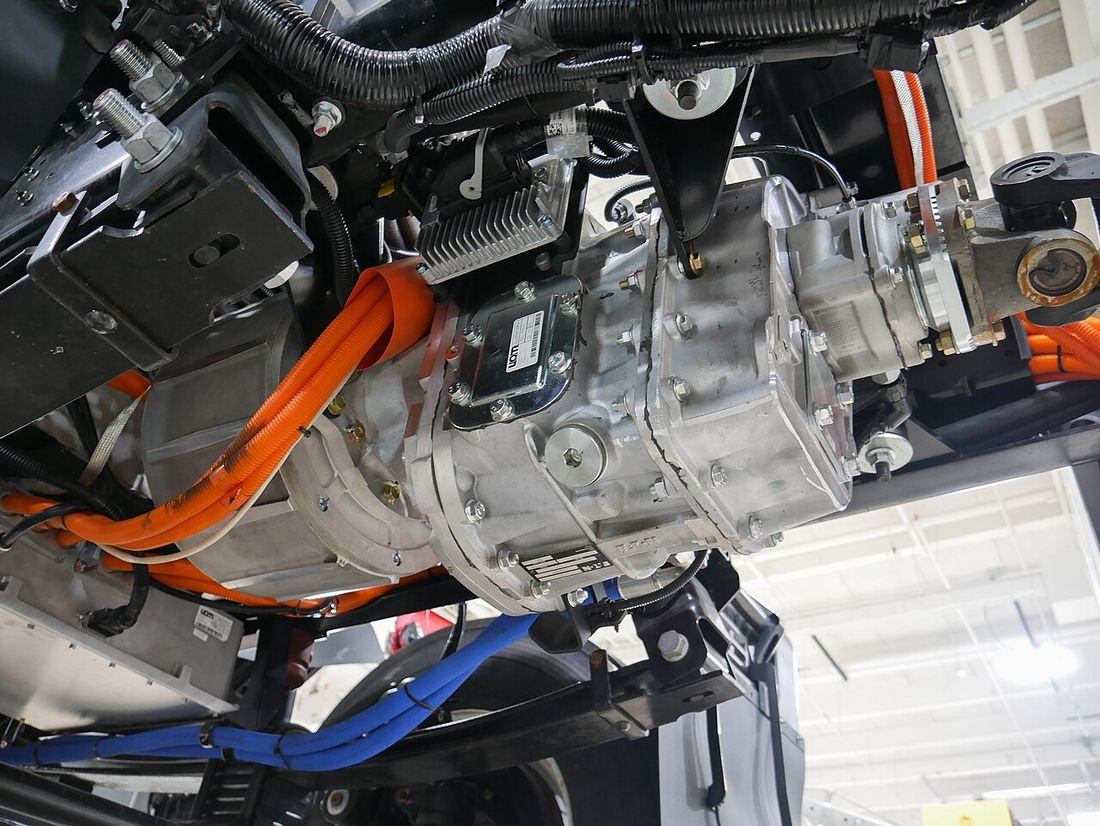
An electric drive unit: motor, reduction gear and inverter in one housing. The thick orange cables are the giveaway — orange means high voltage on every EV. Photo: Foxcorner, CC BY-SA 4.0, Wikimedia Commons
Why the EV goes so much further on “less” energy
It comes down to one number: efficiency. A good petrol engine converts only about 25 to 35 percent of its fuel's energy into movement; the rest leaves as heat and noise. An electric drivetrain converts roughly 75 to 90 percent of the battery's energy into movement. That is why a 60 kWh battery — the energy equal of a few litres of petrol — can carry a family car 230 to 300 miles.
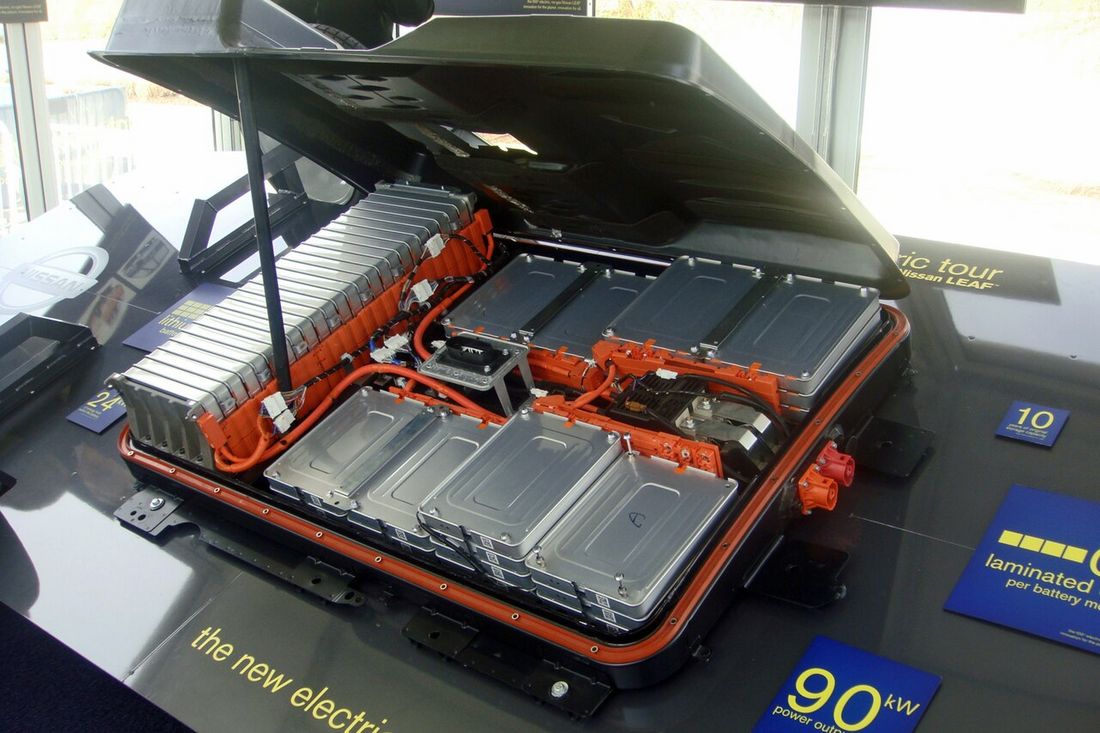
The battery pack is a flat slab under the floor — which is also why EVs feel so planted in corners: several hundred kilograms of weight sit as low as physically possible. Photo: Mariordo (Mario Roberto Durán Ortiz), CC BY-SA 3.0, Wikimedia Commons
Electric vs petrol, side by side
Question
Electric car
Petrol car
Energy stored as
Electricity in a battery (40–100 kWh typical)
Petrol in a tank (typically 40–65 litres)
Energy turned into motion
About 75–90%
About 25–35% (best engines near 40%)
Power delivery
Full torque from 0 rpm, instant response
Torque builds with revs; peak often at 4,000+ rpm
Gearbox
Single fixed ratio, no gear changes
5–10 ratios, manual or automatic
Refuel / recharge
Overnight at home, or 10–80% in roughly 20–40 min on a DC fast charger
About 5 minutes at a pump
Braking energy
Partly recovered into the battery
Lost as heat in the brakes
Routine servicing
No engine oil, plugs, exhaust or clutch; brakes last longer thanks to regeneration
Oil, filters, plugs, belts, exhaust and clutch all wear out
Mistakes and misunderstandings to avoid
Charging to 100% every night. Lithium batteries age fastest when held full or empty. For daily use, most makers advise charging to around 80% and saving 100% for long trips (cars with LFP batteries are the exception — their manuals often recommend a full charge weekly).
Believing the range figure is a promise. Official range is a lab test. Cold weather, motorway speeds and a roof box can each cut real range by 10 to 30 percent.
Treating orange cables as ordinary wiring. Anything orange under an EV carries 400 to 800 volts. Looking is fine; touching, cutting or unplugging is not — ever.
Ignoring the 12-volt battery. EVs still have a small 12 V battery for locks, lights and computers. When it dies, the car can refuse to “start” even with a full main battery.
Safety noteAn EV's main battery and orange high-voltage cabling can deliver a fatal shock and are sealed for a reason. This guide is an explanation only — high-voltage work belongs to trained EV technicians with insulated tools and protective equipment.
Quick questions
How long does an EV battery last?
Modern packs are typically warranted for 8 years or 100,000 miles (160,000 km) to at least 70% capacity, and most lose only about 10 to 20 percent of their range over that life.
Can an EV drive through deep water or a car wash?
Yes. The battery and motor are sealed units, and EVs pass the same water tests as petrol cars — many have official wading depths just like any other car.
Why do EVs still have a “gearbox” at all?
Only a single reduction gear: the motor spins up to ten times faster than the wheels, so one fixed gear ratio bridges the gap and multiplies the pulling force.
Engines & Electric
How a Hybrid Car Works, Step by Step
A hybrid carries both a petrol engine and an electric motor, and its whole talent is knowing which one should work — and when. Follow one through a normal drive and the logic becomes obvious.
AutoFacts guide · 8 min read · Engines & Electric
The cast of parts
A full hybrid (the self-charging kind, which never plugs in) has five key parts: a petrol engine tuned for efficiency, one or two electric motors, a small battery — usually only 1 to 2 kWh, about one-fortieth the size of an EV's — a power-split device or clutch pack connecting everything, and a computer that makes thousands of decisions a minute. Plug-in hybrids (PHEVs) are the same idea with a bigger battery, typically 8 to 20 kWh, that can also charge from a socket.
The small battery surprises people. A hybrid does not store much energy — it recycles it. The battery is a bucket that catches energy you'd otherwise waste, holds it for a few minutes, and pours it back at the exact moment the petrol engine would be least efficient.
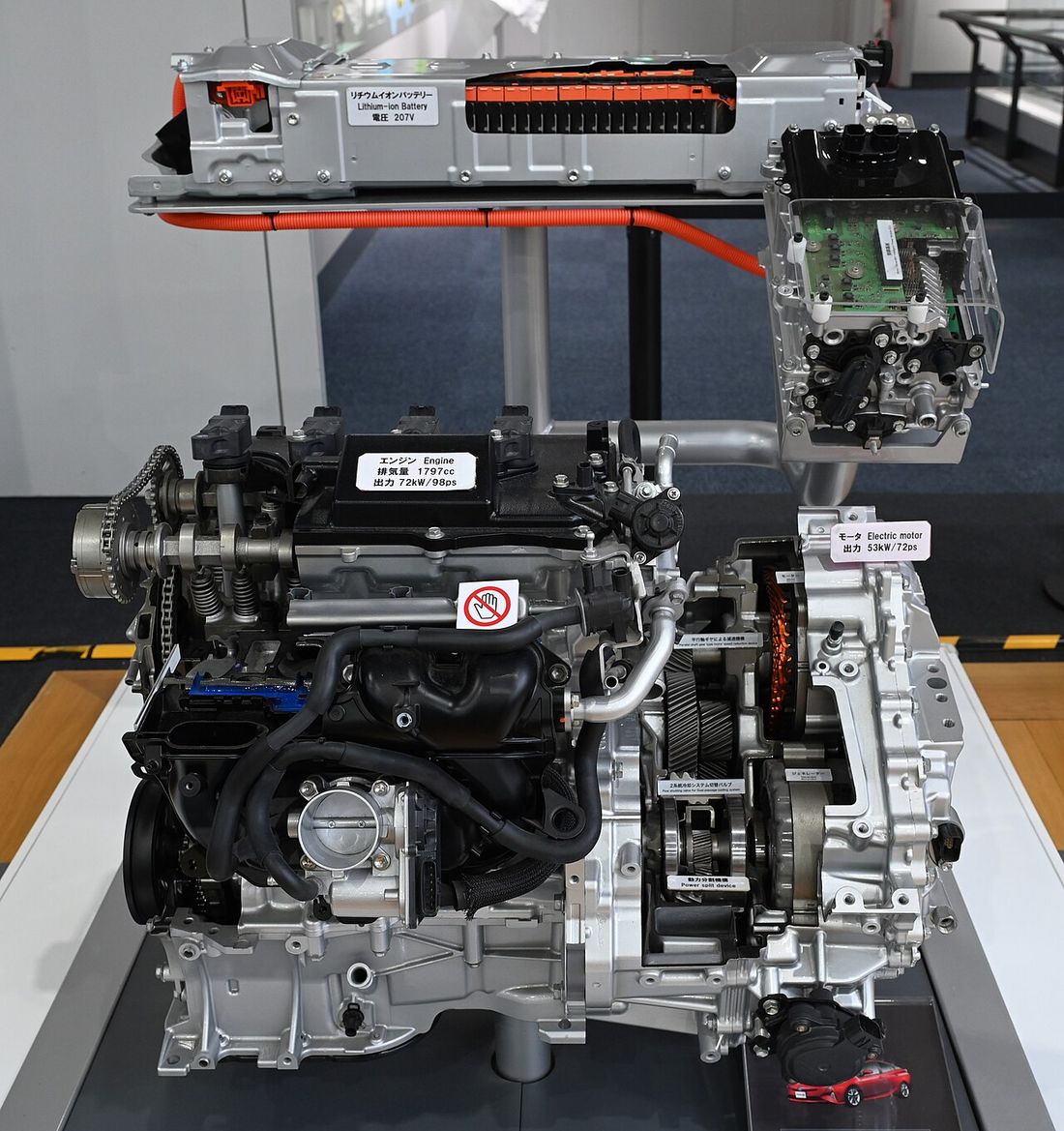
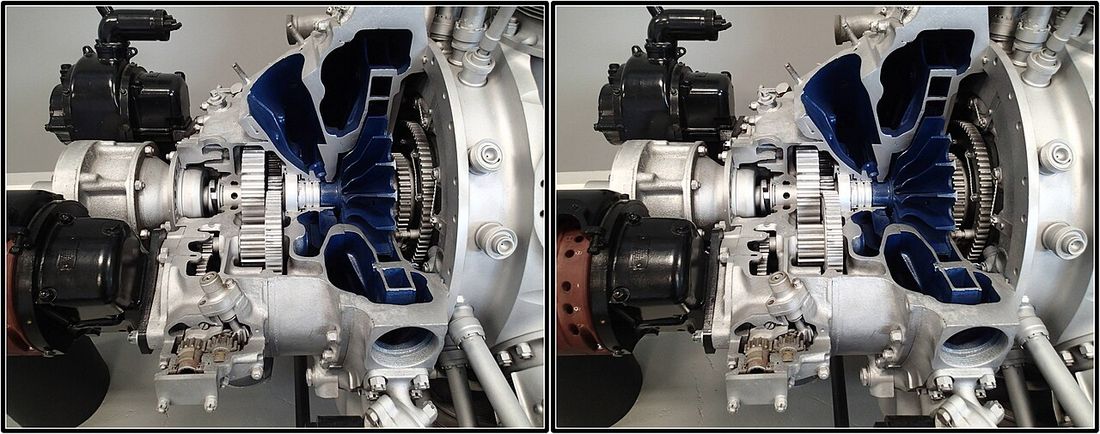
A complete hybrid system laid out: lithium-ion battery (top), inverter (right), petrol engine (bottom left) and electric motor built into the transmission (right). Photo: TTTNIS, CC0, Wikimedia Commons
One drive, step by step
Starting and creeping: motor only. Pull away from rest and the electric motor does the work alone. Electric motors are at their best from a standstill, and petrol engines at their worst — so the hybrid simply skips the engine's weakest moment. This is why hybrids glide out of parking spaces in silence.
Gentle town driving: mostly electric. At low speeds and light throttle, the car stays on the motor, drawing from the small battery. The engine wakes only when the battery dips or you ask for more speed.
Speeding up: both together. Press harder and the petrol engine starts and joins in. Now the two power sources blend: the engine provides the bulk, the motor fills the gaps, and the car gets the combined output of both.
Cruising: engine in charge — and charging. At a steady 50 to 70 mph (80 to 110 km/h) the petrol engine is in its efficient zone, so it drives the wheels directly. Any spare capacity is diverted to top up the battery for the next slow section.
Slowing down: regenerative braking. Lift off or brake gently and the motor turns into a generator, converting the car's movement into electricity for the battery. Only firm braking brings the normal friction brakes fully into play — which is why hybrid brake pads often last twice as long.
Stopping: everything off. At a red light the engine shuts down completely. A hybrid in traffic burns no fuel at all while it waits — the single biggest reason hybrids shine in city fuel-economy tests.
The battery is kept in the middle. The system deliberately holds the battery roughly between 40 and 80 percent charged, never full, never empty, so there is always room to catch braking energy and always some in reserve to help the engine.
A cutaway hybrid: the petrol engine and motor sit together at the front, the battery hides under the rear seat or boot floor, and thick orange cables link them. Photo: TTTNIS, CC0, Wikimedia Commons
The clever bit: the Atkinson-cycle engine
Most hybrid petrol engines use a trick called the Atkinson cycle: the intake valve is held open a little longer, effectively making the engine's expansion stroke longer than its compression stroke. It squeezes more work out of each drop of fuel — the best hybrid engines reach about 40 to 41 percent thermal efficiency, among the highest of any production petrol engine. The trade-off is weak low-speed pulling power, which the electric motor conveniently covers.
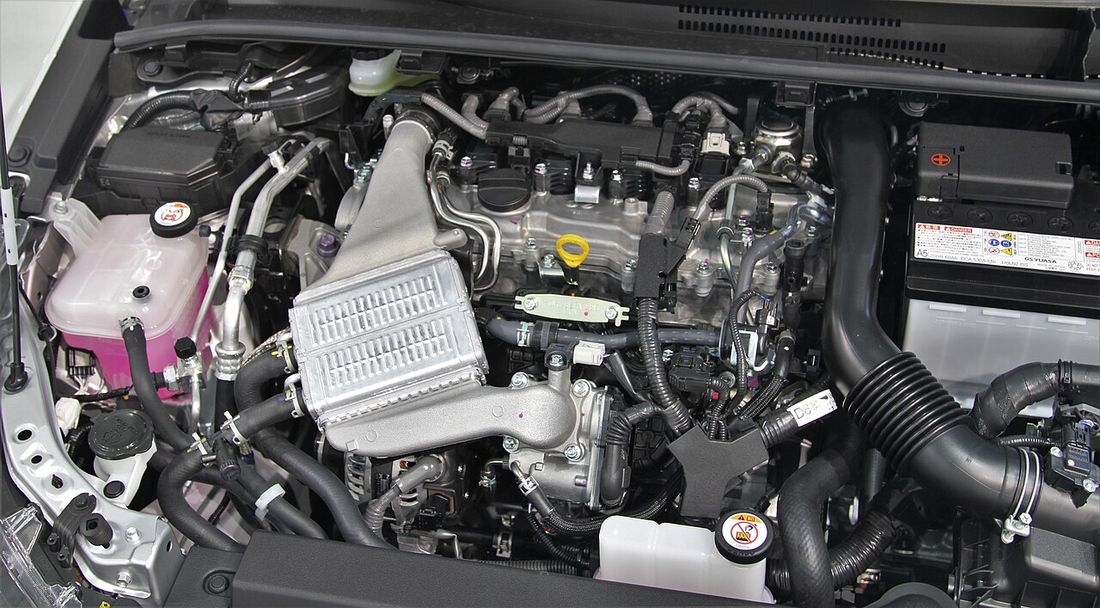
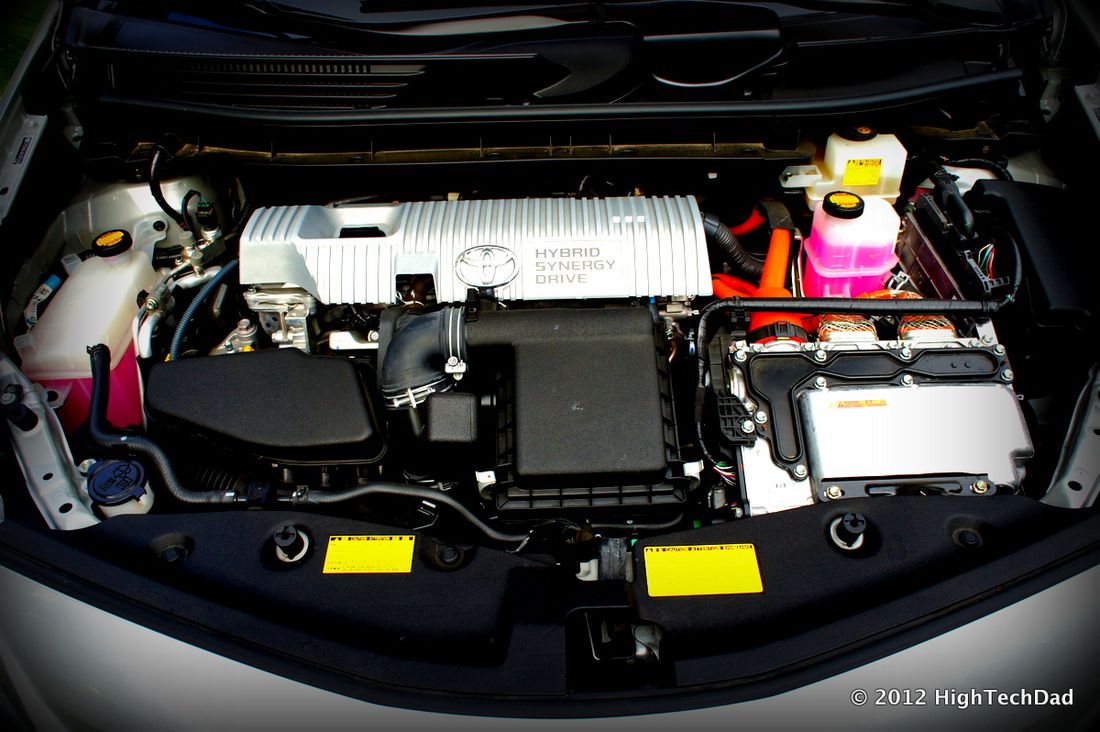
Under a hybrid's bonnet it looks like an ordinary engine bay — until you spot the orange high-voltage cables and the inverter sitting where a conventional part would be. Photo: Michael Sheehan, CC BY 2.0, Wikimedia Commons
Three hybrid flavours, honestly compared
Type
Battery
Can it drive on electricity alone?
Best at
Mild hybrid (MHEV)
Very small, often 48 V
Essentially no — the motor only assists
Cheapest way to trim fuel use and smooth stop-start
Full hybrid (HEV)
1–2 kWh
Yes, for short distances at low speed
City and mixed driving with no plugging in
Plug-in hybrid (PHEV)
8–20 kWh
Yes, typically 25–50 miles (40–80 km)
Short daily trips on electricity, long trips on petrol — if you actually charge it
Common faults and owner mistakes
Never charging a plug-in hybrid. A PHEV driven on petrol alone carries a heavy empty battery and can use more fuel than the ordinary version. The economy figures only exist if it plugs in regularly.
Blocked battery cooling. Many hybrids cool their battery with cabin air drawn through a vent near the rear seat. Cover that vent with luggage or let its filter clog and the battery overheats and ages early.
Long periods parked. Hybrids left unused for months can let both the 12 V battery and the hybrid battery sink too low. A monthly drive of 20 minutes keeps both healthy.
Assuming the engine “cutting out” is a fault. The engine stopping at lights, and restarting with a slight shudder, is the system working as designed.
Safety noteHybrid batteries run at 200 to 300 volts (more in plug-ins) — enough to kill. Orange cables and battery cases are not owner-serviceable. Leave anything orange to a hybrid-qualified mechanic.
Quick questions
Do hybrids need to be plugged in?
Full hybrids never do — they charge themselves from the engine and braking. Only plug-in hybrids have a socket, and they work far better if you use it.
What happens when the hybrid battery wears out?
The car does not stop; it gradually behaves more like an ordinary petrol car, using more fuel. Replacement and refurbished packs are widely available, and failure is usually a slow decline, not a sudden death.
Why is hybrid economy worse on the motorway?
Because there is little braking to recycle and the engine must do nearly all the work at speed — the hybrid's advantage lives in stop-and-go driving.
Engines & Electric
Turbocharger vs Supercharger: How Each One Makes Power
An engine's power is limited by how much air it can breathe. Both of these devices are air pumps that force more in — but they are powered in completely different ways, and that one difference changes everything about how the car feels.
AutoFacts guide · 8 min read · Engines & Electric
Why forcing air in makes power
Burning fuel needs oxygen. A cylinder can only burn as much fuel as the air inside it allows, so more air means more fuel can be burned, which means a bigger push on the piston. Squeeze the incoming air to 1.5 times normal pressure and, roughly speaking, a 2.0-litre engine breathes like a 3.0-litre. That pressure above atmospheric is called boost, and typical road cars run 0.5 to 1.5 bar (about 7 to 22 psi) of it.
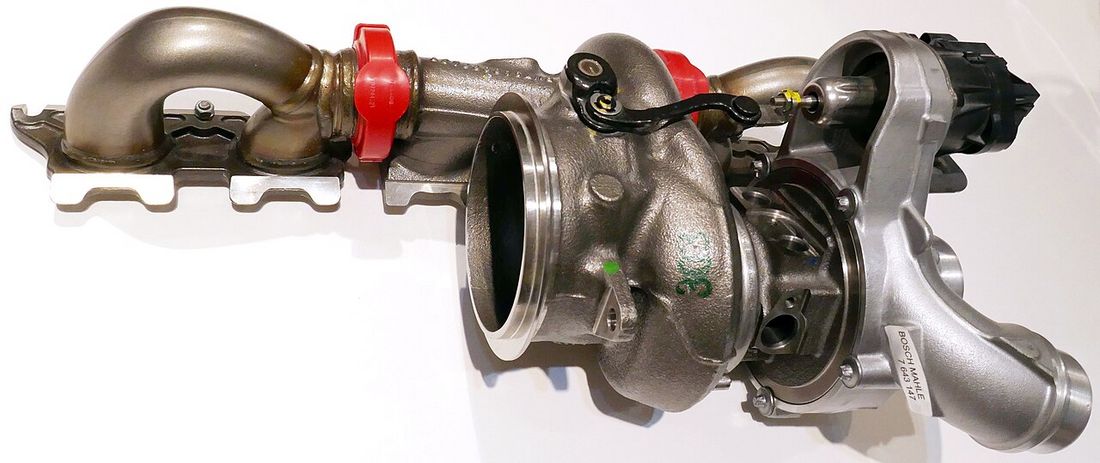
A turbocharger: two fan-like wheels on one shaft — the turbine (right, driven by exhaust) and the compressor (left, which squeezes the intake air). Photo: Quentin Schwinn (NASA), public domain, Wikimedia Commons
The turbocharger, step by step
Exhaust gas leaves the engine still carrying energy — heat and pressure that a normal engine wastes.
That gas is funnelled through a turbine wheel, spinning it up. In a modern turbo the shaft can reach 150,000 to 300,000 rpm.
On the same shaft sits a compressor wheel, which drags in fresh air and squeezes it before sending it to the engine.
Squeezing heats the air, and hot air is less dense — so it passes through an intercooler (a small radiator for air) to cool down before entering the cylinders.
A wastegate opens to bleed off exhaust once enough boost is made, protecting the engine from too much pressure.
The catch is turbo lag: at low revs there is little exhaust energy, so the turbine needs a moment to spin up when you press the accelerator. Modern small, light turbines and twin-scroll designs have shrunk the delay to a fraction of a second, but the physics remains — the turbo's power source only exists once the engine is already working.
The compressor wheel's curved blades are machined to hair-thin tolerances — one reason a turbo's bearings live in engine oil and hate being starved of it. Photo: Tiia Monto, CC BY 4.0, Wikimedia Commons
The supercharger, step by step
A belt from the engine's crankshaft drives the supercharger directly — it is mechanically bolted to the engine's speed.
Inside, either two meshing rotors (Roots or twin-screw types) or a compressor wheel (centrifugal type) squeezes the intake air.
Because the drive is mechanical, boost arrives the instant the engine revs: no waiting, no lag, a perfectly linear push.
The cost: the engine must spend some of its own power turning the pump. A large supercharger at full boost can consume 50 horsepower or more of the power the engine just made.
A Roots-type supercharger sitting on top of a V8 — the classic layout. The belt drive is why its response is instant: the pump's speed is locked to the engine's. Photo: Robbie Sproule, CC BY 2.0, Wikimedia Commons
Head to head
Question
Turbocharger
Supercharger
Powered by
Exhaust gas that would otherwise be wasted
A belt from the crankshaft
Throttle response
A brief delay (lag) while the turbine spins up
Instant, rises in step with revs
Effect on fuel economy
Helps it: small engine, big-engine power only when asked
Hurts it: the engine always pays to turn the pump
Heat to manage
Very high — the turbine glows in exhaust up to about 1,000°C
Moderate
Where it shines
Everyday cars, diesels, efficiency with performance
Muscle cars and drag racing, where instant response wins
Typical sound
A rising whistle and wastegate flutter
A rising mechanical whine
Common faults and owner mistakes
Switching off a hot turbo engine immediately. After hard driving, the turbo is spinning at enormous speed and heat. Idling for 30 to 60 seconds lets oil keep flowing while it cools; killing the engine instantly can cook the oil in the bearings.
Skipping oil changes. A turbo's shaft floats on engine oil at up to 300,000 rpm. Old, dirty oil is the number one turbo killer.
Ignoring boost leaks. A split intake hose makes a turbo work harder for less boost — the symptoms are a whistle under power, black smoke on a diesel, and a car that feels quietly slower.
Overlooking the supercharger belt. On a supercharged car, a worn or slipping belt does not just squeal — boost, power and sometimes the coolant pump and steering assistance all fade with it.
Quick questions
Can an engine have both?
Yes — a few production cars (notably some Volvos and older VWs) use a supercharger for low revs and a turbocharger for high revs, getting instant response and top-end efficiency together.
Why do almost all modern cars choose turbos?
Emissions and economy rules. A small turbocharged engine uses little fuel when driven gently and still makes big-engine power when asked — a supercharger cannot switch its appetite off.
Does boost wear an engine out faster?
Engines designed for boost are built stronger inside (forged parts, extra cooling). Problems come from raising boost beyond the design, not from boost itself.
Engines & Electric
Automatic Gearboxes Compared: Torque Converter vs CVT vs Dual-Clutch
Three gearboxes can all present you with the same simple “D” — yet inside, one stirs fluid, one squeezes a belt between two cones, and one is secretly two manual gearboxes taking turns. Here is how each works and where each belongs.
AutoFacts guide · 9 min read · Engines & Electric
Why a gearbox exists at all
A petrol or diesel engine only makes useful power in a band roughly between 1,500 and 6,000 rpm, and almost none at a standstill. A gearbox is a set of lever ratios that lets that narrow band cover everything from a hill start to motorway cruising. The three automatic designs below solve the same problem with entirely different machinery.
1. The torque-converter automatic: the fluid one
Instead of a clutch, the engine drives a torque converter: a sealed doughnut-shaped housing filled with oil, containing two facing fans (an impeller on the engine side, a turbine on the gearbox side).
The engine spins its fan; the moving oil drags the other fan around with it. The connection is liquid, which is why these gearboxes creep forward gently at idle and shift so smoothly.
At very low speeds the fluid link actually multiplies torque — up to about twice the engine's output — which makes for strong, effortless getaways and good towing manners.
Once cruising, a lock-up clutch joins the two sides mechanically so no energy is wasted stirring oil.
Behind the converter sit planetary gear sets. Clutch packs inside the gearbox hold or release different parts of the gear sets to produce today's typical 8, 9 or 10 ratios.
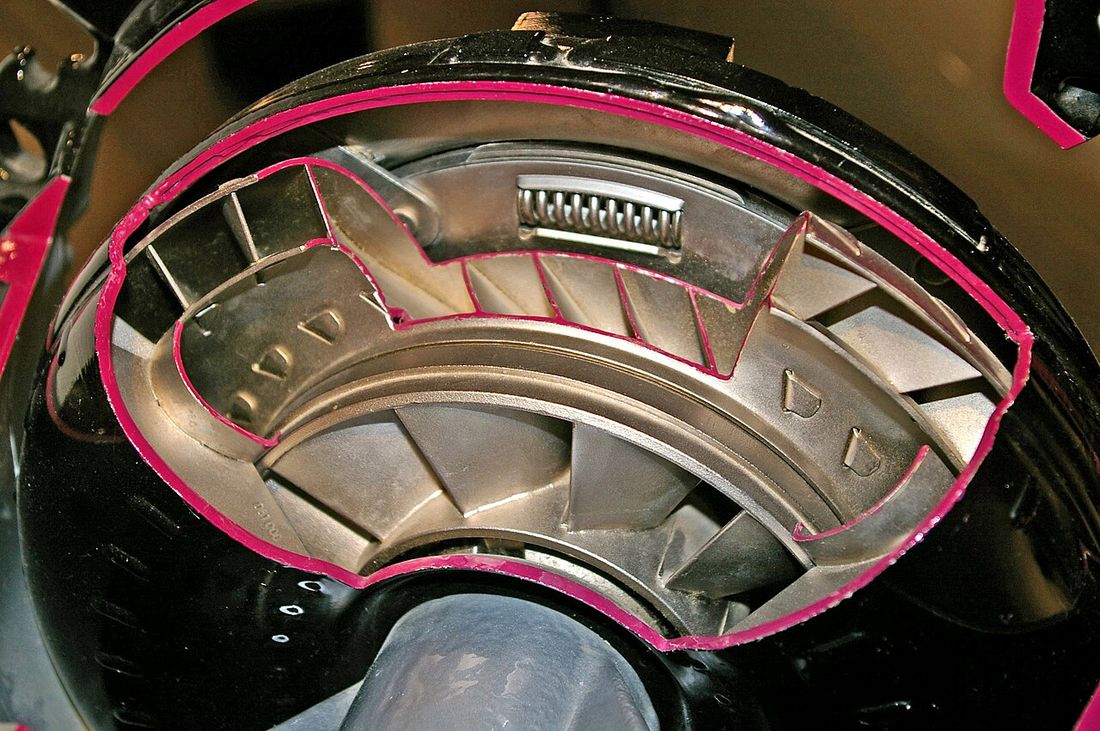
A torque converter cut open: the curved blades of the impeller and turbine face each other across a bath of oil. No solid connection at all — just moving fluid. Photo: BerndB~commonswiki (assumed), CC BY-SA 3.0, Wikimedia Commons
2. The CVT: the one with no gears to count
A continuously variable transmission uses two pulleys shaped like opposing cones, joined by a steel belt or chain.
Each pulley can squeeze narrower or wider. As one narrows and the other widens, the belt rides higher or lower on each, changing the ratio smoothly — like a bicycle derailleur, but stepless.
There are no fixed gears at all: the ratio glides through an infinite spread, letting the engine sit at its most efficient revs while the road speed changes.
That is why a CVT car accelerates with the revs holding steady and the speed climbing — the famous “rubber-band” feel is the ratio moving, not slipping.
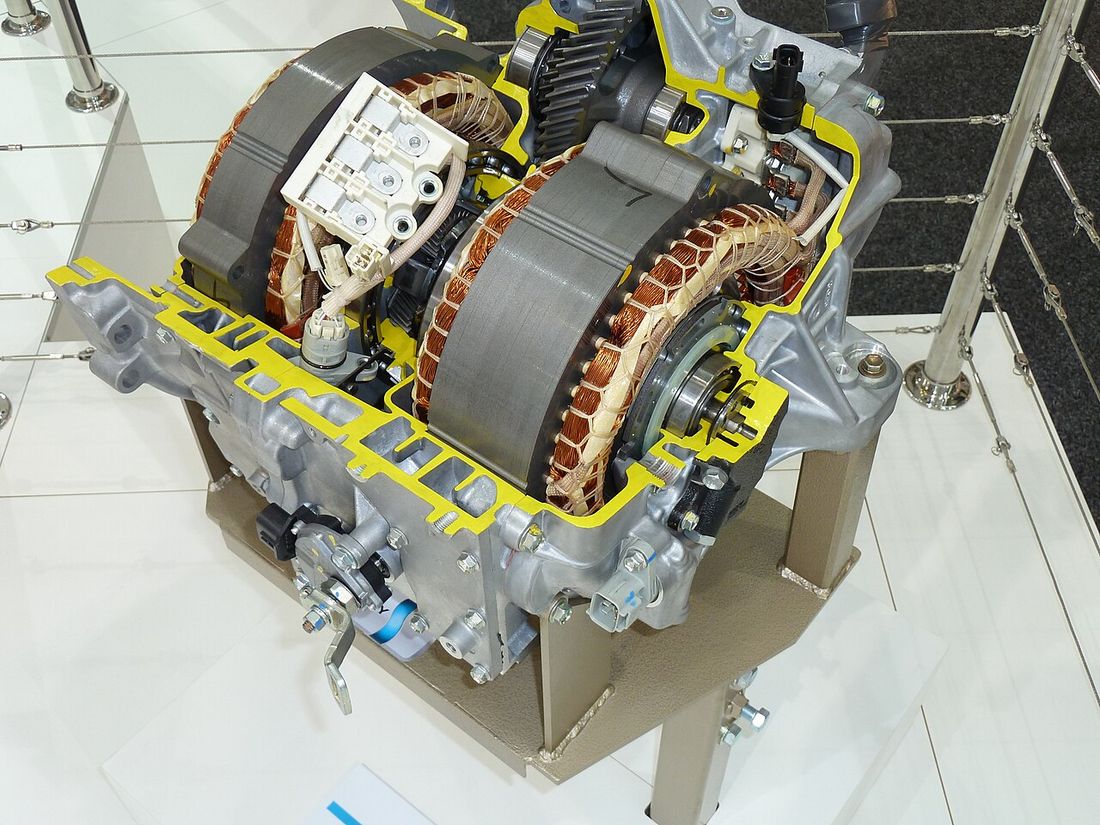
Toyota's hybrid “e-CVT” is a different animal wearing the same name: it has no belt at all, just two electric motors and a planetary gear set blending engine and motor power.
This cutaway is Toyota's hybrid e-CVT: no belt, no pulleys — the two copper-wound electric motors and a planetary gear set do the ratio blending electronically. Photo: OSX, public domain, Wikimedia Commons
3. The dual-clutch (DCT): two gearboxes, one casing
Inside a dual-clutch box there are two manual-style gear sets: one carries the odd gears (1, 3, 5, 7), the other the even gears (2, 4, 6), each with its own clutch.
While you accelerate in 3rd, the other shaft has already selected 4th and is waiting.
The shift is a swap: one clutch opens as the other closes, in as little as 8 to 100 milliseconds — faster than any human with a gear lever.
Because the connection is solid gears and clutches (wet ones bathed in oil, or dry ones like a manual car's), almost no power is lost on the way through.
The weakness shows at walking pace: at parking speeds the clutches must slip like a learner driver's, so cheap dry-clutch DCTs can feel jerky in traffic and can overheat on long hill crawls.
A seven-speed dual-clutch unit on display. Think of it as two manual gearboxes sharing one housing, with a computer working both clutches. Photo: Spielvogel, CC0, Wikimedia Commons
The honest comparison
Question
Torque converter
CVT
Dual-clutch
How it shifts
Fluid link + planetary gears; smooth and forgiving
No fixed gears; ratio slides continuously
Pre-selected gears swapped between two clutches; near-instant
Feel
Relaxed, creamy, strong creep at idle
Steady revs, “rubber-band” under hard acceleration
Crisp and sporty; can be jerky at parking speeds
Efficiency
Good in modern 8–10 speed form with lock-up
Excellent in gentle driving
Excellent — close to a manual
Heavy towing
Best of the three; the fluid link multiplies torque and absorbs shock
Weakest; belts have torque limits
Capable in wet-clutch form; dry-clutch versions dislike it
Best home
SUVs, trucks, luxury cars, tow vehicles
Small and medium family cars, hybrids
Hot hatches, sports cars, keen drivers' family cars
Common faults and owner mistakes
Believing “sealed for life” fluid claims. Gearbox oil degrades in every design. Many specialists recommend fresh fluid every 40,000 to 60,000 miles (64,000–97,000 km) regardless of what the brochure promised — cheap insurance against the most expensive component in the car.
Creeping a DCT on a hill. Holding a dual-clutch car on the throttle instead of the brake cooks its clutches. Use the brake or the hill-hold, like you would in a manual.
Towing beyond the CVT's rating. Belt CVTs have strict torque and towing limits. Exceed them and the belt slips, overheats and can destroy the pulleys.
Ignoring early symptoms. Delayed engagement, flare (revs jumping during a shift), shuddering or new whines are the gearbox asking for attention while the fix is still fluid and filters — not after, when it means a rebuild.
Quick questions
Which automatic lasts longest?
Historically the torque converter, treated kindly and given fresh fluid, has the longest record — it's also the most tolerant of abuse. A well-maintained example of any type beats a neglected one of any other.
Why does my CVT “shift” if it has no gears?
It doesn't have to — many makers program in fake steps because drivers distrust steady revs. The steps are software theatre, not hardware.
Is a dual-clutch just an automatic manual?
Almost exactly: manual-style gears and clutches, worked by computer. That is why it shares both the manual's efficiency and its low-speed clutch manners.
Ownership & Problems
How ABS Brakes Work — and Why the Pedal Pulses
In a panic stop, a locked wheel doesn't slow you down — it turns your car into a sled. ABS exists to stop the lock-up, many times per second, faster than any human foot. Here is the machinery behind the juddering pedal.
AutoFacts guide · 7 min read · Ownership & Problems
The problem ABS solves
A rolling tyre grips the road; a locked, sliding tyre mostly doesn't — and a sliding front tyre cannot steer at all. In an emergency, stamping on the brakes of a car without ABS locks the wheels: stopping distances grow, and turning the steering wheel does nothing. ABS (anti-lock braking system) keeps each wheel right at the edge of locking, where grip is highest, so you can brake hard and steer around the obstacle.
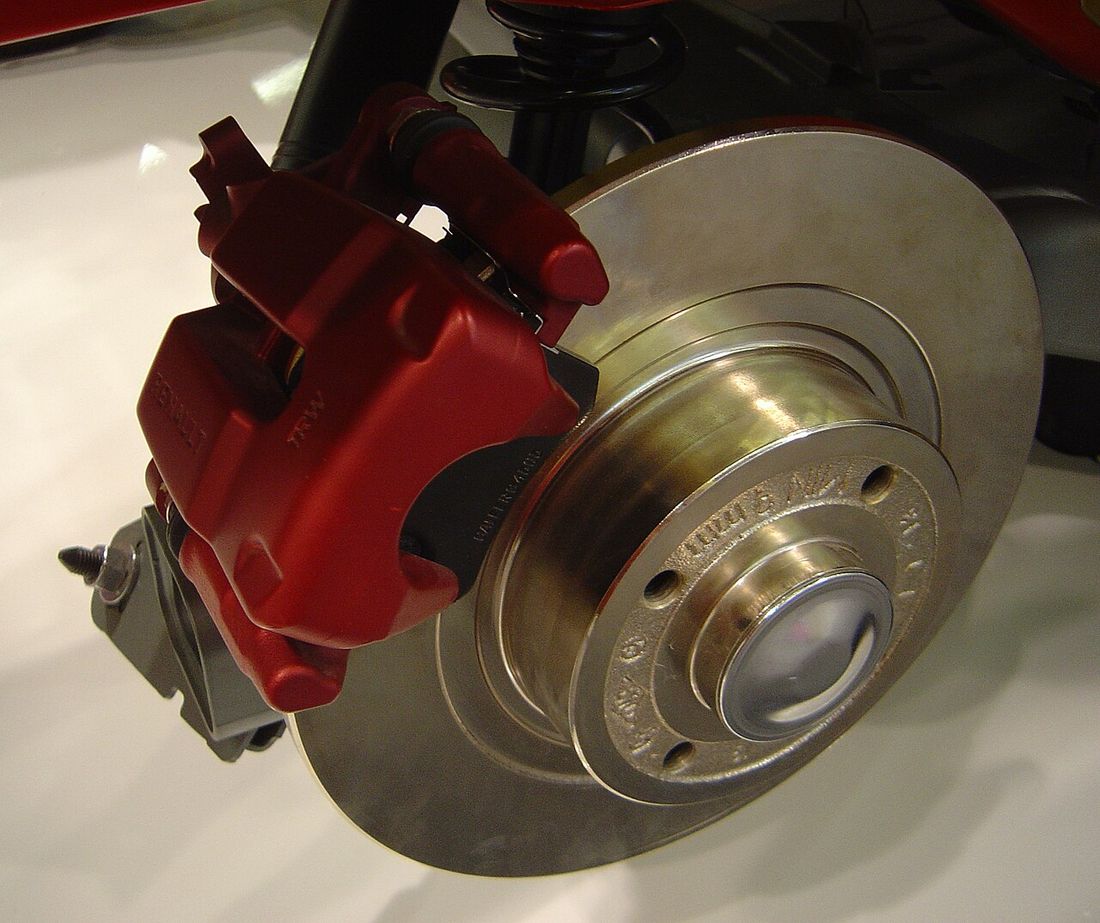
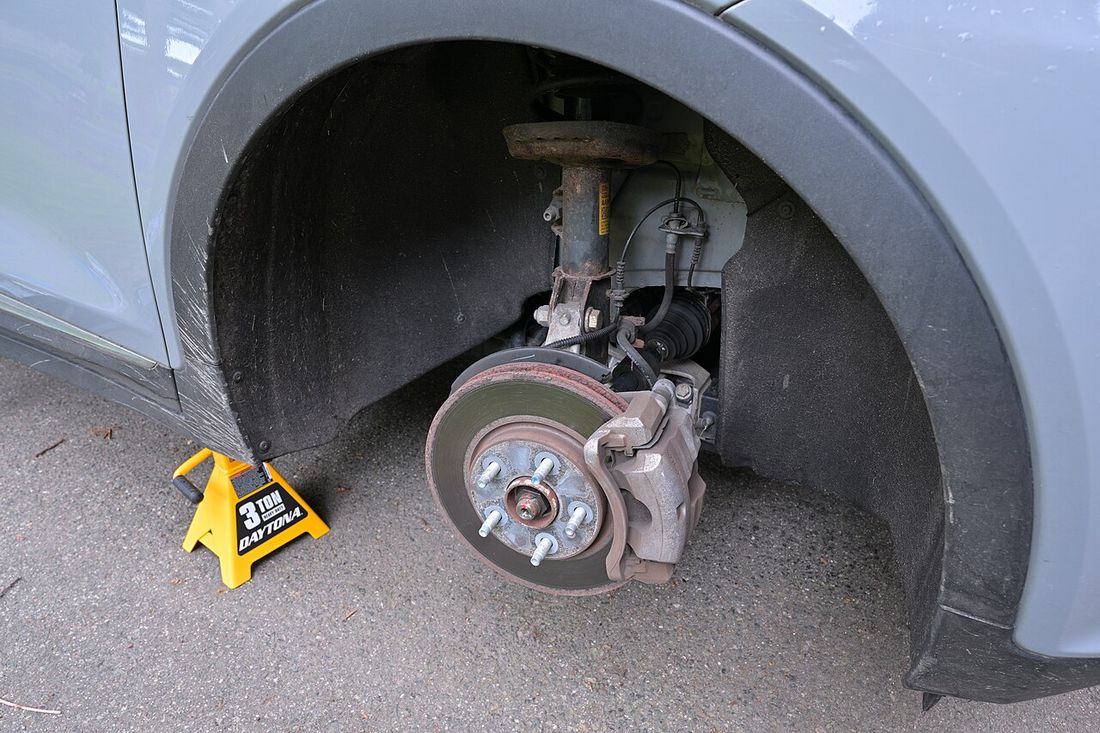
The hardware ABS commands: a disc, a caliper that squeezes it, and — just out of the spotlight — a speed sensor watching the wheel's rotation many times per second. Photo: 4300streetcar, CC BY 4.0, Wikimedia Commons
Step by step, in the half-second it matters
Sensors watch every wheel. A toothed ring (a tone ring, typically with dozens of teeth) spins with each wheel, and a sensor counts the teeth passing. The ABS computer knows each wheel's speed, updated dozens of times per second.
You brake hard. One wheel starts to slow much faster than the car itself — the signature of a wheel about to lock.
The modulator steps in. A hydraulic unit between the master cylinder and each brake can hold, release or reapply pressure to each wheel independently, using solenoid valves and a pump.
Pressure is released just enough. The locking wheel is allowed to spin back up to road speed. Grip returns.
Pressure is reapplied — and the cycle repeats. Hold, release, reapply, up to about 15 times per second. That rapid cycling is exactly what you feel as pulsing or kicking through the pedal, and the growling noise is the pump and valves working.
You keep steering. Because no wheel ever fully locks, the front tyres still respond to the steering wheel. Brake and swerve at the same time — that combination is the entire point.
Most cars brake with discs like this at the front. The vents between the disc's two faces pump air through to shed heat — a single hard stop from motorway speed turns a surprising amount of motion into heat. Photo: Wikimedia Commons contributor, CC BY-SA 3.0, Wikimedia Commons
ABS vs no ABS: what actually changes
Situation
With ABS
Without ABS
Emergency stop, dry road
Short stop, full steering control
Wheels may lock; longer, unsteerable slide
Emergency stop, wet road
Biggest advantage: grip preserved, car stays steerable
Easy lock-up, car slides straight on
Loose gravel or deep snow
Sometimes slightly longer stop — the tyre cannot dig in and build a wedge of material
A locked wheel can dig in and stop shorter, but with no steering
Pedal feel
Pulses and vibrates — normal, keep pressing
Stays firm while the wheels are locked
Tyre wear in a panic stop
Even, because wheels keep rotating
Flat-spots where the locked tyre dragged
The ABS wheel-speed sensor usually reads a toothed ring on the hub or driveshaft, just behind this assembly. Corrosion or a cracked ring is the most common cause of an ABS warning light. Photo: 4300streetcar, CC BY 4.0, Wikimedia Commons
Common faults and driver mistakes
Taking your foot off when the pedal pulses. The most dangerous ABS mistake of all. The pulsing means the system is working — the correct response is to keep pressing, hard, and steer.
Pumping the pedal yourself. Good advice in 1975, wrong now. Pumping fights the computer and lengthens the stop. Press once, firmly, and let the system cycle.
Ignoring the ABS warning light. With the light on, the system has usually switched itself off: ordinary braking remains, but the anti-lock protection is gone until the fault — often just a sensor or its ring — is fixed.
Believing ABS defies physics. ABS preserves steering and uses available grip well; it cannot create grip. On ice, the correct stopping distance is still “much longer than you think”.
Safety noteBrakes are the one system where there is no safe DIY learning curve: incorrect brake work can kill. This guide explains the system; any repair to brakes, brake lines or the ABS modulator belongs to a qualified mechanic. If your brake pedal ever feels soft, spongy or sinks to the floor, do not drive the car — have it recovered.
Quick questions
Is the crunching noise during ABS operation a fault?
No. The pump and valves cycling up to 15 times a second are genuinely noisy, and the pedal kick is strong. Both are the system working as designed.
Why does my ABS sometimes trigger on a bumpy road at low speed?
A wheel bouncing over a pothole can momentarily slow or skip, fooling the sensor into seeing a near-lock. A brief pulse at crawling speed on rough ground is common; constant false triggering means a sensor needs checking.
Does ABS help on ice?
It preserves steering, which can save you — but grip is so low that distances stay long. Winter tyres make a far bigger difference than any braking electronics.
Ownership & Problems
Why Engines Overheat: The 6 Common Causes — and What Ignoring Each One Costs
An engine is a controlled fire, and the cooling system is the only thing standing between normal running and a warped, seized lump of metal. When the temperature needle climbs, it is almost always one of these six.
AutoFacts guide · 8 min read · Ownership & Problems
Thirty seconds on how cooling works
Coolant — a mix of water and antifreeze — is pumped through channels in the engine, where it picks up heat, then through the radiator, where airflow dumps that heat. A thermostat acts as a gatekeeper, keeping coolant inside the engine until it reaches working temperature (most engines run with coolant around 90–105°C / 195–220°F), and the whole system is pressurised so the coolant can run hotter than 100°C without boiling. Every overheating story is a failure somewhere in that loop: not enough coolant, coolant not moving, or heat not escaping.
The translucent bottle with the coloured fluid is the coolant reservoir — the one level every driver can and should check monthly, between its MIN and MAX marks, on a cold engine. Photo: Colin Venable, CC0, Wikimedia Commons
The six usual culprits
Low coolant from a leak. The most common cause of all. Coolant escapes from split hoses, a tired radiator, a weeping water pump or a loose clamp — slowly at first, as a falling level in the reservoir. With too little coolant, the remaining fluid cannot carry the heat away. Cost of ignoring it: the leak only grows; the end of the story is a warped cylinder head or a seized engine.
A thermostat stuck shut. The thermostat is a wax-and-spring valve that should open as the engine warms. If it sticks closed, coolant never reaches the radiator and the temperature climbs within miles. Cost of ignoring it: a small part's failure overheats the whole engine just as surely as an empty system.
A failing water pump. The pump — driven by belt, chain or an electric motor — is the system's heart. Worn bearings growl and wobble; plastic impellers can crack or spin loose on their shaft, so the pump turns but the coolant barely moves. Cost of ignoring it: total loss of circulation, plus whatever the thrown belt takes with it.
A blocked or clogged radiator. Inside, old or wrong coolant leaves scale and sludge in the radiator's fine tubes; outside, the fins choke with insects, leaves and road dirt. Either way, heat cannot get out. Cost of ignoring it: an engine that only overheats at speed or under load — the classic “fine in town, cooks on the motorway” pattern.
A cooling fan that has stopped working. At road speed, moving air cools the radiator; in traffic, the electric fan does the job. A failed fan motor, relay or temperature sensor means the car is fine at 60 mph and boils at the first red light. Cost of ignoring it: repeated traffic-jam overheating quietly cooks head gaskets and ages everything under the bonnet.
A blown head gasket. The gasket seals the cylinders from the coolant passages. When it fails, combustion gas is forced into the cooling system (bubbling in the reservoir, hoses rock-hard) or coolant leaks into the cylinders (white exhaust vapour, milky oil). Sometimes the gasket is the original failure — but more often it is the victim of one of the five causes above being ignored. Cost of ignoring it: the largest bill on this page, below.
Cooling fans like these are the radiator's lungs at low speed. If the temperature climbs in traffic but falls once you are moving, the fan system is the first suspect. Photo: simonov, CC BY-SA 2.0, Wikimedia Commons
What it costs: fixing the cause vs ignoring it
Typical US workshop price ranges, parts and labour combined — your car and region will vary, but the shape of the table is true everywhere: every cause is cheap compared with the damage it causes.
Fault
Fixing the cause, roughly
If ignored until the engine is damaged
Leaking hose or clamp
$150–$350
Warped cylinder head / head gasket: roughly $1,500–$3,500. A seized engine needing replacement: $4,000–$8,000+ — often more than the car is worth.
Thermostat
$200–$450
Water pump
$450–$900
Radiator
$550–$1,100
Cooling fan / relay / sensor
$150–$600
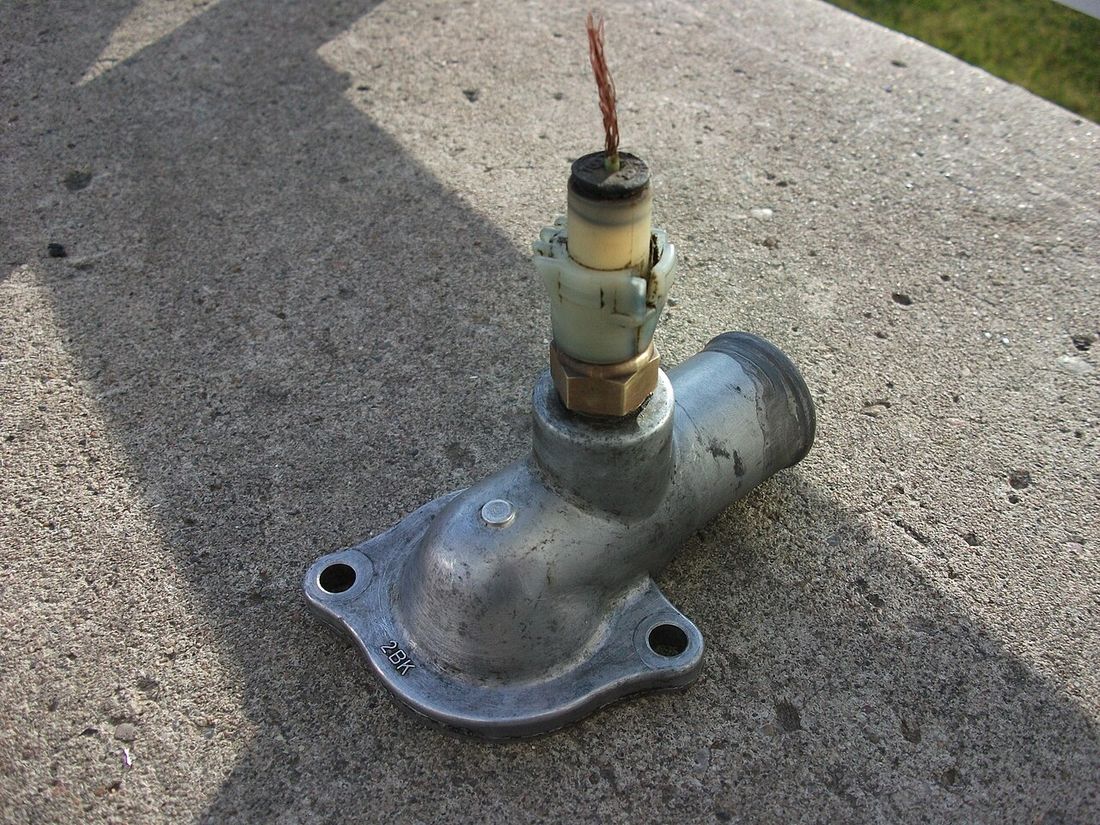
A thermostat housing with a fresh thermostat — a modest part (often under $50) whose failure can destroy an engine worth a hundred times more. Photo: dave_7, CC BY 2.0, Wikimedia Commons
If the needle climbs while you are driving
Act early. Turn the cabin heater to full hot and the fan to maximum — uncomfortable, but it dumps engine heat into the cabin and genuinely helps.
Ease off. Reduce speed and load; avoid hard acceleration and long hills.
Stop somewhere safe if it keeps rising — or immediately if the gauge hits the red, a warning light appears, or steam shows. Switch off and wait at least 30–45 minutes.
Never open the reservoir or radiator cap on a hot engine. The system is pressurised with fluid above boiling point; opening it can cause serious scalds. Check levels only when the engine is fully cold.
Never keep driving “just a few more miles”. Aluminium cylinder heads warp quickly once overheated. Those few miles are where a $250 repair becomes a $3,000 one.
Safety notePressurised coolant at 120°C causes severe burns, and overheated engines can spray steam without warning. Let everything cool completely before touching anything, and leave cooling-system repairs to a qualified mechanic.
Quick questions
Can I top up with plain water in an emergency?
Yes — water beats an overheated engine. But have the system refilled with the correct coolant mix soon after: plain water boils earlier, freezes in winter and corrodes from the inside.
My temperature rises only in traffic. What is that?
The classic signature of a fan problem (cause 5) — at road speed the moving air does the fan's job and hides the fault.
Is a slightly low coolant level normal?
A few millimetres over a year is unremarkable, but the system is sealed: a level that keeps dropping means a leak, and leaks only ever get bigger.
Ownership & Problems
Strange Car Noises, Decoded: What Each Sound Usually Means
Cars rarely fail in silence. Weeks before the breakdown there is usually a squeal, a hum or a knock that most drivers turn the radio up to avoid. This is the translation guide — what each sound usually means, and how fast you need to act.
AutoFacts guide · 8 min read · Ownership & Problems
How to “read” a noise before you decode it
Mechanics diagnose sounds with four questions, and you can answer all four from the driver's seat. What does it sound like? When does it happen — braking, turning, accelerating, idling, or over bumps? Does it change with road speed or with engine revs? And is it getting worse? Note the answers before visiting a workshop and you will save real diagnostic time and money.
Brake pads carry a tiny metal tab — the wear indicator — designed to squeal against the disc when the pad is nearly finished. The noise is not a failure; it is a scheduled announcement. Photo: A7N8X, CC BY-SA 3.0, Wikimedia Commons
The sound dictionary
The sound
When it happens
What it usually means
Urgency
High-pitched squeal
While braking
Brake pads at their wear limit — the indicator tab is touching the disc
Book it in soon; days to a couple of weeks
Squeal or chirp
From the engine bay, worst on a cold start, fades as you rev
A worn or loose drive belt (or a tired belt tensioner) driving the alternator and pumps
Soon — a snapped belt can stop the alternator and water pump
Grinding
While braking
Pads worn completely through; metal is now grinding the disc itself
Urgent — every mile adds disc damage and stopping distance
Deep knock or thump
Rises and falls with engine revs, worst under load
Urgent — bearing knock can destroy the engine; stop and have it checked
Hum or drone
Grows with road speed, changes when you steer gently left-right
A worn wheel bearing (the sound shifts as weight transfers in corners)
Soon — bearings progress from noisy to dangerous
Clunk
Over bumps, potholes and speed humps
Worn suspension joints, bushings or anti-roll bar links
Book it in; handling and tyre wear suffer
Ticking or tapping
From the engine, often loudest when cold
Valve gear wear, low oil level, or a small exhaust manifold leak
Check the oil today; book in if it persists
Hissing
After switching off, or steam with a sweet smell
Coolant escaping from a hose, the radiator or the reservoir cap
Soon — see the overheating guide before it escalates
Whine
Changes pitch with revs or road speed
Alternator bearings, low gearbox or power-steering fluid, or normal turbo whistle (a siren-like rising whine that is new is not normal)
Soon; mention exactly when it happens
One belt drives the alternator, pumps and more. Its cold-start chirp is the engine bay's most common early-morning complaint — and usually its cheapest fix. Photo: Bill Abbott, CC BY-SA 2.0, Wikimedia Commons
Two noises worth understanding properly
The braking grind is the expensive sequel to the braking squeal. The squeal was the warning, delivered for free by a piece of bent tin. Once the friction material is gone, the pad's steel backing plate carves into the disc: the disc must then be replaced along with the pads, and braking power in the rain falls noticeably. Same fault, two different bills — separated only by how long the squeal was ignored.
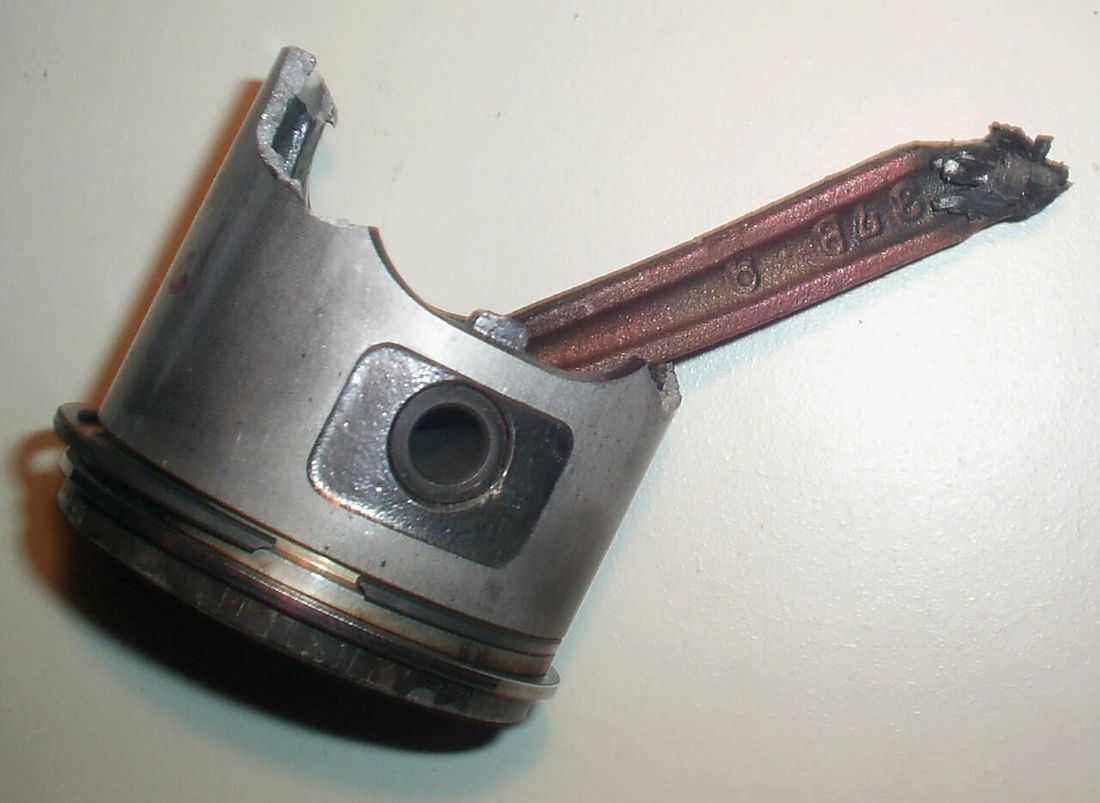
Where unchecked engine knock ends: a failed piston and connecting rod. Not every knock is this serious — but this is why a rev-linked deep knock is never a “turn the radio up” noise. Photo: Kallemax, public domain, Wikimedia Commons
The cornering hum is a neat self-test. A failing wheel bearing drones louder as it takes more load. On a quiet road at 40 to 50 mph (65–80 km/h), gently weave: if the hum grows turning left, the right-side bearing (loaded in a left turn) is the suspect, and vice versa. Tyre noise is the common false alarm — rotate the tyres and if the sound “moves”, it was rubber, not bearings.
Mistakes that make noises cost more
Describing a noise as “a funny sound somewhere”. Use the four questions above — what, when, speed-linked or rev-linked, getting worse? A two-sentence description can halve diagnostic time.
Spraying belt dressing on a squealing belt. It silences the symptom for a week while the belt keeps deteriorating — and a snapped belt can take the water pump drive with it, converting a small bill into an overheating event.
Assuming every noise is the engine. Loose heat shields, a stone in a brake dust shield and worn drop links imitate serious faults brilliantly. Some of the worst sounds have the cheapest causes — which is why diagnosis comes before parts.
Waiting for a noise to “become obvious”. Sounds are cheapest at the whisper stage. Bearings hum for weeks before they wobble; brakes squeal before they grind.
Safety noteA grinding brake, a deep engine knock, a hum with a wobbling wheel or any noise accompanied by a warning light, smoke or a change in how the car steers or stops means: slow down, stop somewhere safe, and have the car inspected or recovered. Do not “test it a bit longer” at motorway speed.
Quick questions
Can I record the noise for my mechanic?
Yes — a phone recording from the driver's seat, with you narrating what the car is doing (braking, turning, speed), is genuinely useful. Have a passenger hold the phone; never film while driving.
Why do so many noises appear on cold mornings?
Cold rubber belts are stiff, oil is thick, clearances are at their widest and damp belts slip. Morning squeals and ticks that vanish within minutes are common; ones that persist when warm are the ones to chase.
My EV makes almost no noise. Is that a problem for diagnosis?
The opposite: electric cars keep the same suspension, bearings and brakes, and without engine noise those hums, clunks and squeals are easier to hear — and appear earlier.
Engines & Electric
How a Car Battery and Alternator Work Together
One is a sprinter, one is a marathon runner. The battery's only real job is to start the engine; the alternator then powers the whole car and repays the battery's effort. Most “battery problems” are actually a breakdown in that partnership.
AutoFacts guide · 7 min read · Engines & Electric
Two jobs, two very different machines
The 12-volt lead-acid battery is a reservoir: six cells of lead plates in acid, each making about 2.1 volts, storing a modest amount of energy but able to release it in a violent burst. The alternator is the opposite: a small generator bolted to the engine, driven by a belt, able to produce power continuously for as long as the engine runs — typically 70 to 150 amps — but useless when the engine is off. The car needs both, for different moments of its life.
The battery: smaller than most people expect, because its energy store barely matters — what matters is the burst of 200 to 600 amps it can deliver to the starter motor on a cold morning. Photo: Azorbli, CC BY-SA 4.0, Wikimedia Commons
Step by step: one start, one journey
Resting. Everything off, the battery sits at about 12.6 volts when fully charged (12.2 volts is roughly half-charged; 11.9 or below is effectively flat). This “surface” voltage is the quickest health clue there is.
The starter's burst. Turn the key or press the button and the battery spends its stored burst: the starter motor draws 150 to 300 amps for a second or two, and the battery voltage dips to around 10 volts while cranking. This is the battery's whole purpose — a few seconds of enormous effort.
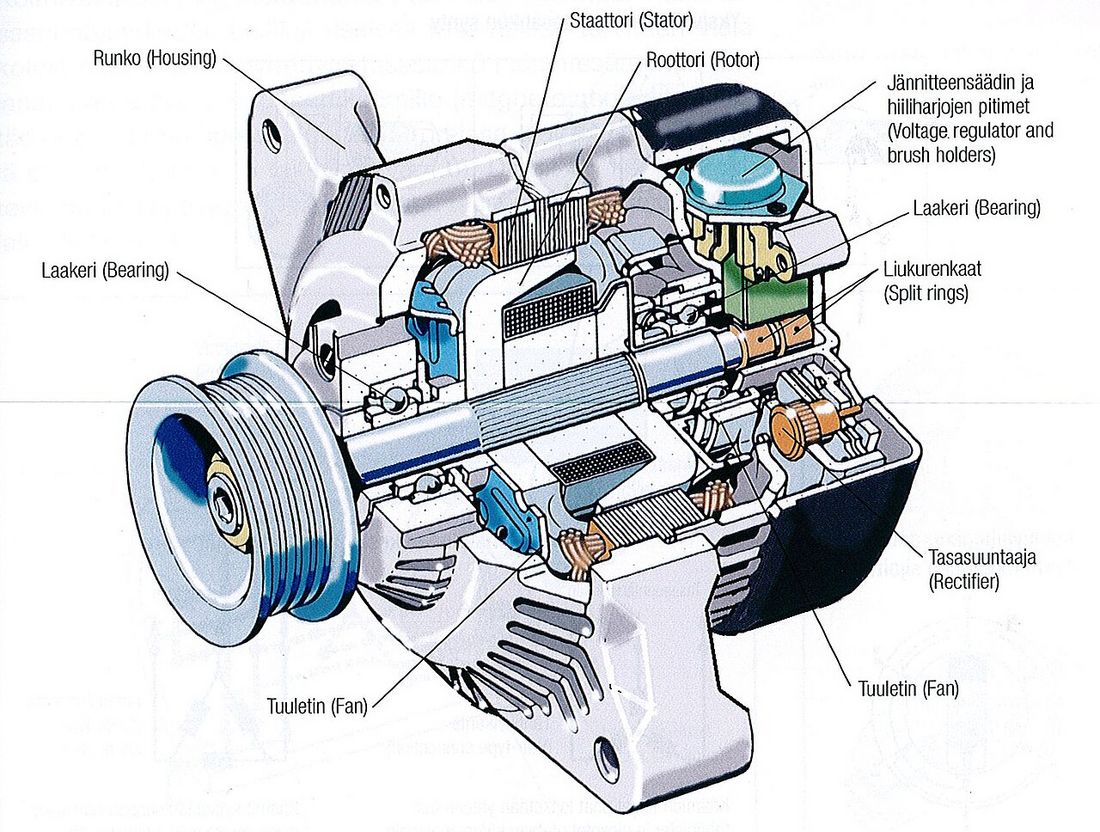
The alternator takes over. The instant the engine runs, the belt spins the alternator. Inside, a magnetised rotor spins within copper windings; the resulting alternating current is converted to DC by a diode pack, and a voltage regulator holds the output at about 13.8 to 14.4 volts — deliberately higher than the battery's 12.6, so current flows into the car and back into the battery.
Everything now runs on the alternator. Lights, heaters, fans, computers, seat warmers — all powered by the alternator, not the battery. The battery acts only as a stabiliser and backup, smoothing the voltage.
The loan is repaid. Within the first minutes of driving, the alternator replaces the energy the start consumed. A healthy system finishes most journeys with the battery fuller than it started.
A new alternator before fitting: pulley at the front (belt-driven), cooling fins and vents around the windings, and the regulator and diode pack inside. Photo: dave_7, CC BY 2.0, Wikimedia Commons
Telling the two apart when trouble starts
Symptom
Points to the battery
Points to the alternator
Engine cranks slowly, especially after standing overnight
✓ Classic — the battery is old or discharged
Only if it also fails to recharge the battery
Rapid clicking, engine will not crank
✓ Too weak to hold the starter engaged
—
Battery warning light on while driving
—
✓ The light means “not charging”, whatever its picture shows
Lights dim and brighten with engine revs
—
✓ Regulator or diode trouble
Car starts with a jump, then dies shortly after
—
✓ The engine was running on the battery alone and emptied it
Fine all week, flat on Monday
✓ Age (typical life 4–6 years) or a parasitic drain
—
Burning smell or whine from the engine bay
—
✓ Alternator bearings or an overworked, overheating unit
An alternator's business end: the thick output terminal feeds the battery, and the whole unit lives in the hottest, dirtiest corner of the engine bay — remarkable that most last 100,000 miles or more. Photo: Pentti Immonen, public domain, Wikimedia Commons
Common faults and owner mistakes
Replacing the battery when the alternator is at fault. A new battery on a dead alternator works beautifully — for about a day. Any battery replacement on a car over six years old deserves a charging-voltage check (13.8–14.4 V at the terminals with the engine running) before money is spent.
Short trips, again and again. A start costs the battery more than a five-minute drive repays. Cars used only for school runs slowly starve their batteries; an occasional 30-minute drive or a smart charger fixes it.
Corroded terminals. The green or white crust on battery posts resists current both ways — weak starts and poor charging from a five-minute cleaning problem.
Jump-starting and immediately switching off. An idling engine for two minutes replaces almost nothing. After a jump start, drive for at least 20 to 30 minutes.
Safety noteBattery acid is corrosive and batteries release flammable hydrogen gas while charging. Wear eye protection, keep sparks and flames away, connect jump leads in the order your owner's manual states, and never lean over a battery while connecting it. If in any doubt, call breakdown assistance instead.
Quick questions
What does CCA mean on a battery label?
Cold Cranking Amps: the current the battery can deliver for 30 seconds at −18°C (0°F). It is the figure that decides whether a frosty morning start happens — bigger engines and diesels need more of it.
Does an EV or hybrid have an alternator?
Usually not. A DC-DC converter steps the main battery's high voltage down to charge the 12 V battery instead — same job, no belt, no moving parts.
Can a failing alternator kill a good battery?
Yes, in both directions: undercharging leaves the battery sulphated and weak, while a faulty regulator overcharging boils the battery dry. The two are a partnership in sickness as well as health.
Engines & Electric
Petrol vs Diesel Engines: The Real Differences
They look alike, they both burn fuel in cylinders — but one lights its fuel with a spark and revs happily to 6,000 rpm, while the other squeezes air until the fuel ignites itself, and pulls like a train at half the revs. The differences all flow from that single decision.
AutoFacts guide · 8 min read · Engines & Electric
The one difference that explains all the others
A petrol engine mixes fuel and air, squeezes the mixture to about a tenth of its volume (a compression ratio of roughly 10:1 to 12:1), and lights it with a spark plug. A diesel engine squeezes air alone far harder — 16:1 to 22:1 — until that air is hot enough (well above 500°C) that fuel sprayed into it ignites on contact. No spark plugs, no throttle plate, and an engine that must be built much stronger simply to survive its own squeeze.
That extra squeeze is the diesel's superpower: higher compression extracts more work from every drop of fuel. It is also the reason diesels are heavier, louder at idle, and more expensive to build.
A modern small petrol engine: lighter, cheaper and happier to rev, with spark plugs and (usually) a turbocharger doing the work that displacement used to do. Photo: TTTNIS, CC0, Wikimedia Commons
Each engine's firing cycle, step by step
Intake. Petrol: a fuel-air mixture enters through a throttle that meters how much the engine breathes. Diesel: only air enters, always as much as possible — power is controlled by fuel alone.
Compression. Petrol squeezes the mixture about 10–12 times. Diesel squeezes air 16–22 times, heating it past the fuel's ignition point.
Power. Petrol: the spark plug fires and the mixture burns in a fast flame front. Diesel: injectors spray fuel into the superheated air at pressures up to about 2,000 bar (29,000 psi) and it burns as it enters — a longer, more gradual push, which is why diesels feel so strong at low revs.
Exhaust. Both push the burnt gases out — but diesel exhaust carries soot particles that modern cars trap in a diesel particulate filter (DPF), and nitrogen oxides treated with AdBlue (diesel exhaust fluid) in most modern diesels.
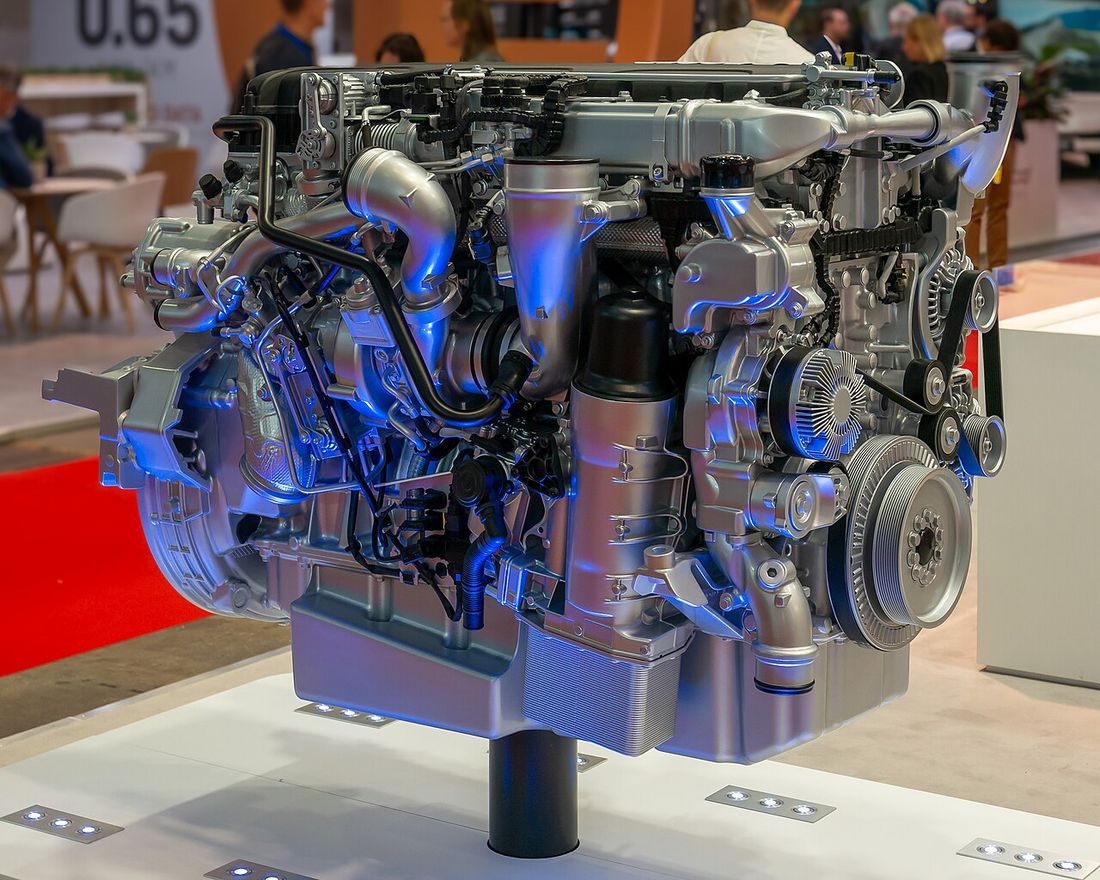
A heavy-duty diesel: note the sheer size of the block and turbo plumbing. Diesel's efficiency and low-rev torque are why virtually every truck on Earth uses one. Photo: MB-one, CC BY-SA 4.0, Wikimedia Commons
The numbers, honestly compared
Question
Petrol
Diesel
Ignition
Spark plug
Compression heat alone (glow plugs only help cold starts)
Compression ratio
About 10:1–12:1
About 16:1–22:1
Energy in the fuel
About 32 megajoules per litre
About 36 megajoules per litre — diesel fuel itself carries ~13% more energy
Typical efficiency
25–35% (best near 40%)
35–42% (large truck diesels exceed 45%)
Character
Revvy, smooth, quieter; power at high revs
Strong pull from low revs; heavier, gruffer at idle
Torque of a typical 2.0-litre
Roughly 200–300 Nm (turbo petrol)
Roughly 350–450 Nm
Fuel economy
Good
Typically 20–30% better, litre for litre
Emissions profile
More CO₂ per litre burned; cleaner particulates
Less CO₂ per mile; more NOx and soot unless treated (DPF + AdBlue)
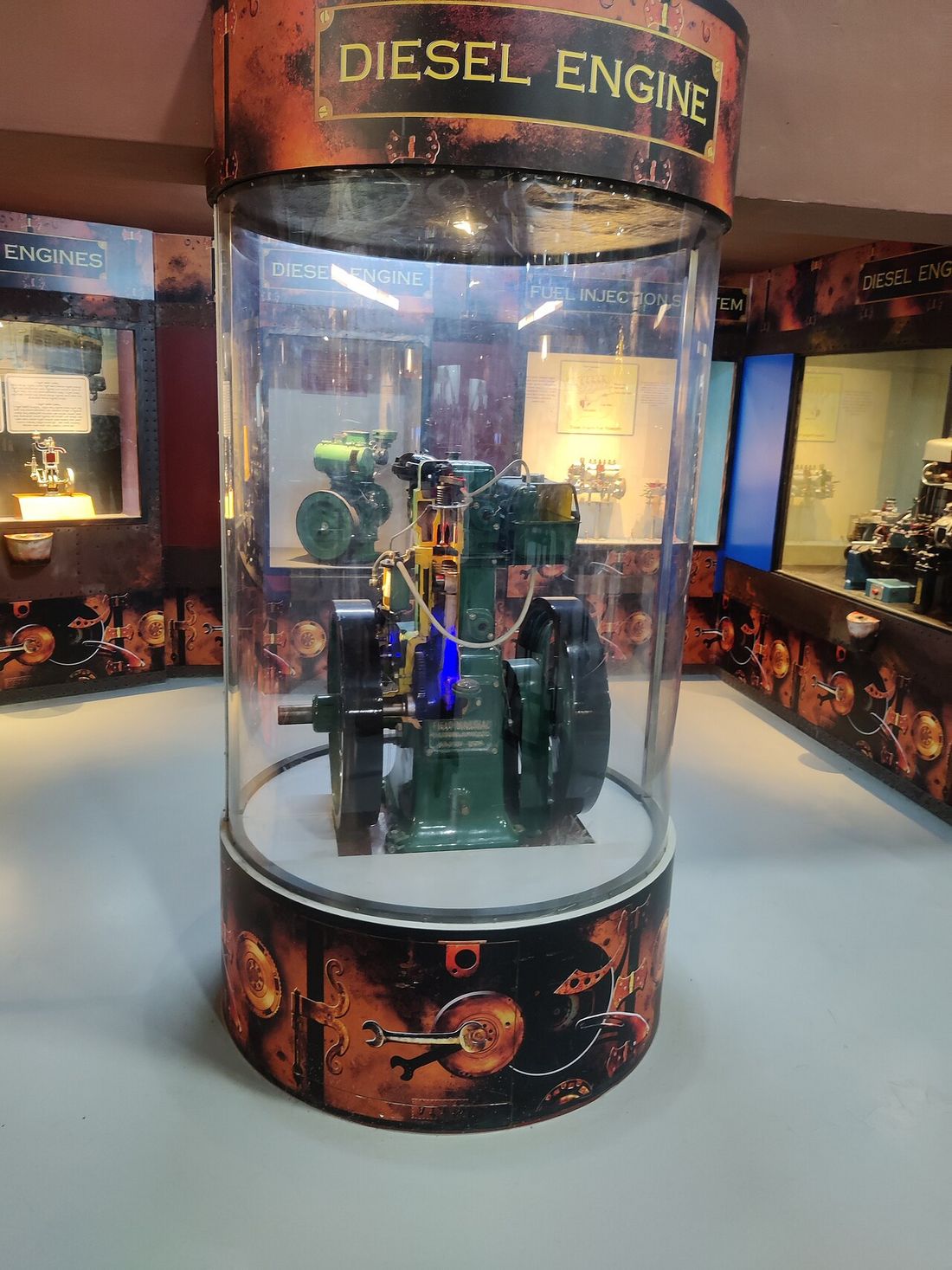
An early industrial diesel: Rudolph Diesel's 1890s design was so much more efficient than steam that it conquered ships, trains and trucks long before it reached cars. Photo: Kaartic, CC BY-SA 4.0, Wikimedia Commons
Maintenance and ownership: where the costs differ
Item
Petrol
Diesel
Routine servicing
Spark plugs, coil packs; generally cheaper services
No plugs, but bigger oil capacity and pricier filters; generally costlier services
Fuel system
Injectors at modest pressure; tolerant
Extreme-pressure injectors and pump — very costly parts, sensitive to dirty fuel
Emissions hardware
Catalytic converter
DPF, EGR and usually AdBlue/SCR — each a future repair bill
Short-trip suitability
Fine
Poor: the DPF needs regular longer runs at speed to clean itself; a diet of short trips clogs it
Putting in the wrong fuel
Diesel in a petrol car: smoky, may not run, usually flushable
Petrol in a diesel: genuinely destructive — it strips the lubrication the fuel pump relies on. Do not start the engine
Common faults and owner mistakes
Buying a diesel for a life of short trips. The fuel saving never arrives, and the particulate filter clogs because it never gets the sustained heat it needs to regenerate. A diesel earns its keep on long, regular drives.
Ignoring the DPF warning light. The light is asking for one steady motorway drive so the filter can clean itself. Keep postponing it and the “drive it” fix becomes a “replace it” fix.
Misfuelling. Diesel nozzles are wider than petrol filler necks to protect petrol cars, but a petrol nozzle fits a diesel easily. If you ever realise mid-fill in a diesel: stop, do not start the engine, and call for a drain.
Judging by horsepower alone. A 150 hp diesel and a 150 hp petrol feel nothing alike — the diesel's torque arrives at half the revs. Compare the torque figure and where it peaks.
Quick questions
Why are diesels louder at idle?
Ignition by compression is a sudden pressure spike rather than a smooth flame — the famous diesel “knock” is the sound of the fuel igniting all at once. Modern injection splits the fuel into several tiny doses to soften it.
Which is better for towing?
Diesel, clearly: its torque arrives at low revs, exactly where towing works, and its fuel advantage grows under load.
Are diesels being banned?
Several cities restrict older diesels, and many makers are phasing diesel cars out in favour of hybrids and EVs — but a modern, clean diesel remains legal and sensible for high-mileage drivers in most places.
Engines & Electric
How Power Steering Works: Hydraulic Muscle, Electric Brains
Turning the front wheels of a stationary car against the grip of two tyres should be heavy work — and on old cars, it was. Two different technologies learned to hide that effort; the newer one also quietly saves fuel and enables half the driver-assistance features in a modern car.
AutoFacts guide · 7 min read · Engines & Electric
The base system both types share
Under nearly every modern car is a rack and pinion: your steering wheel turns a pinion gear, which meshes with a toothed bar — the rack — connected to both front wheels. Turn the wheel and the rack slides left or right, pushing the wheels around. It is simple, direct and precise. The “power” part is whatever helps you slide that rack.
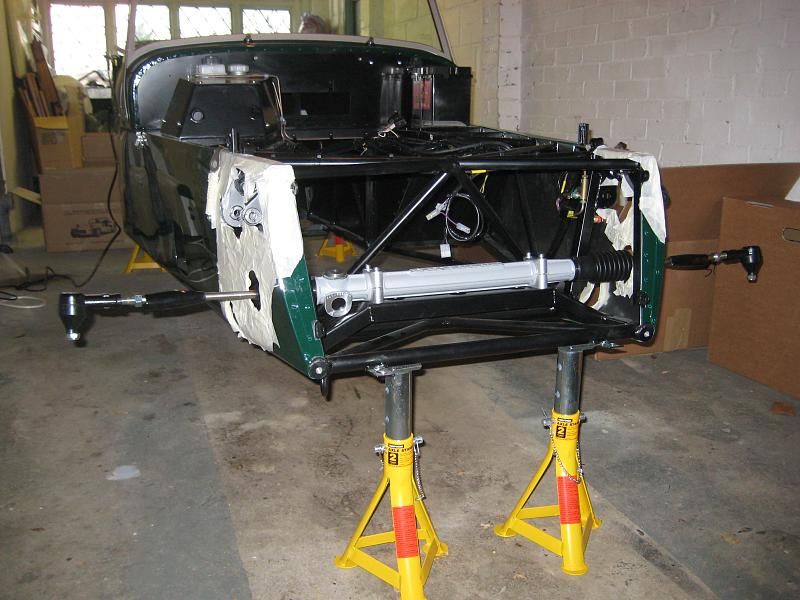
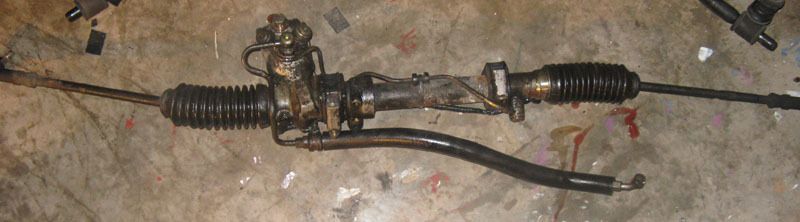
A steering rack off the car: the pinion housing in the middle is where the steering column connects, and the track rods at each end reach out to the wheels. Photo: l0lnix, CC BY 2.0, Wikimedia Commons
Hydraulic power steering, step by step
A pump, driven by a belt from the engine, pressurises hydraulic fluid — typically to 70–100 bar (about 1,000–1,450 psi) when working hard.
The fluid waits in a rotary valve on the steering column, which senses your turning effort through the twist of a slender torsion bar.
Turn left and the valve directs pressurised fluid to a piston on the left side of the rack; turn right and it switches sides. The piston's push does most of the work; your hands supply the instruction.
The harder you turn, the more the torsion bar twists and the more fluid the valve admits — assistance proportional to effort, which is why good hydraulic steering still feels wonderfully natural.
The costs: the pump is driven whenever the engine runs, even in a straight line on the motorway, sipping roughly 2 to 4 percent of the car's fuel. And the system adds fluid, hoses, seals and a reservoir to maintain.
The hydraulic side of the bargain: a belt-driven pump and its fluid reservoir. Low fluid here is the first check when hydraulic steering goes heavy or starts groaning. Photo: Kakoula10, CC BY-SA 4.0, Wikimedia Commons
Electric power steering (EPS), step by step
A torque sensor on the steering column measures how hard and which way you are turning.
A control unit combines that with road speed and commands an electric motor — mounted on the column or directly on the rack.
The motor adds exactly the assistance requested: maximum at parking speeds, and deliberately reduced on the motorway, where a light wheel would feel nervous.
When you are driving straight, the motor draws essentially nothing. That on-demand appetite is worth about 3 percent in fuel economy over a hydraulic pump — one reason every mainstream car now uses EPS.
Because the motor can also turn the wheel without you, EPS is the enabling hardware for lane-keeping assistance, self-parking and stability-control steering corrections.
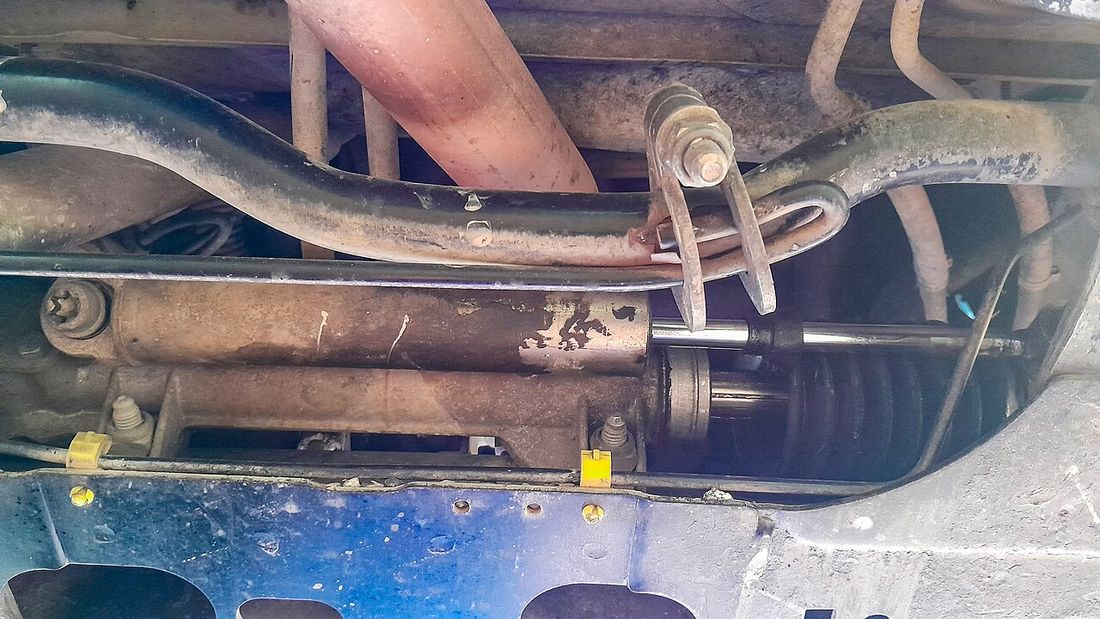
The rack in place under a car, track rods reaching to each wheel hub. Whether the muscle pushing it is hydraulic or electric, this bar does the final work. Photo: vipdesilva, CC BY 2.0, Wikimedia Commons
Hydraulic vs electric, compared
Question
Hydraulic
Electric (EPS)
Power source
Engine-driven pump, running constantly
Electric motor, working only when you steer
Fuel cost
Roughly 2–4% of fuel use
Roughly 0.5–1%, only during steering
Feel
Rich, natural road feedback; enthusiasts still benchmark against it
Early systems felt numb; good modern systems are close, and tuneable per drive mode
Maintenance
Fluid changes, hoses, pump and rack seals can leak
No fluid at all; failures are electronic or motor-related
Extra abilities
Steering only
Lane keeping, park assist, crosswind and pull compensation
Why steering suddenly goes heavy: the real causes
Low tyre pressure — the overlooked first check. A soft front tyre resists turning hard. Check pressures before suspecting the steering itself.
Low power-steering fluid (hydraulic cars). Usually from a small leak in a hose or the rack seals. Heavy steering plus a groan on full lock is the giveaway. Topping up buys time; the leak still needs finding.
A slipping or snapped drive belt. On hydraulic cars the same belt may drive the alternator and water pump — heavy steering with a battery light means stop soon, not eventually.
EPS electrical faults. Electric systems fail safely to “heavy but steerable” by design. Causes range from a weak battery or alternator (EPS needs strong voltage) to a failed torque sensor or motor. A steering warning light accompanies it.
Seized joints or a damaged rack. Worn track-rod ends, a dry ball joint or accident damage can make steering heavy in one direction, or stiff in patches as you turn — a mechanical fault, not an assistance fault.
Safety noteSteering is a primary safety system. If the wheel goes suddenly heavy, notchy, or the car stops responding crisply — or any steering warning light stays on — have the car inspected before driving it further. Never continue a journey fighting a steering fault: the effort needed in an emergency swerve can exceed what you can apply.
Quick questions
Can I still steer if the power assistance fails?
Yes — the mechanical link from wheel to rack is never removed, and the car remains steerable. But the effort at low speed can be enormous, by design margins rather than by comfort.
Why is my EPS heavier in Sport mode?
Deliberately. Makers reduce assistance to give the wheel more weight and feel at speed. If the heaviness is identical in every mode and newly arrived, that is a fault, not a feature.
Does hydraulic fluid really need changing?
It darkens and gathers moisture and wear particles over the years; many specialists refresh it around 50,000–60,000 miles (80,000–97,000 km). It is cheap compared with a pump or rack.